The short answer
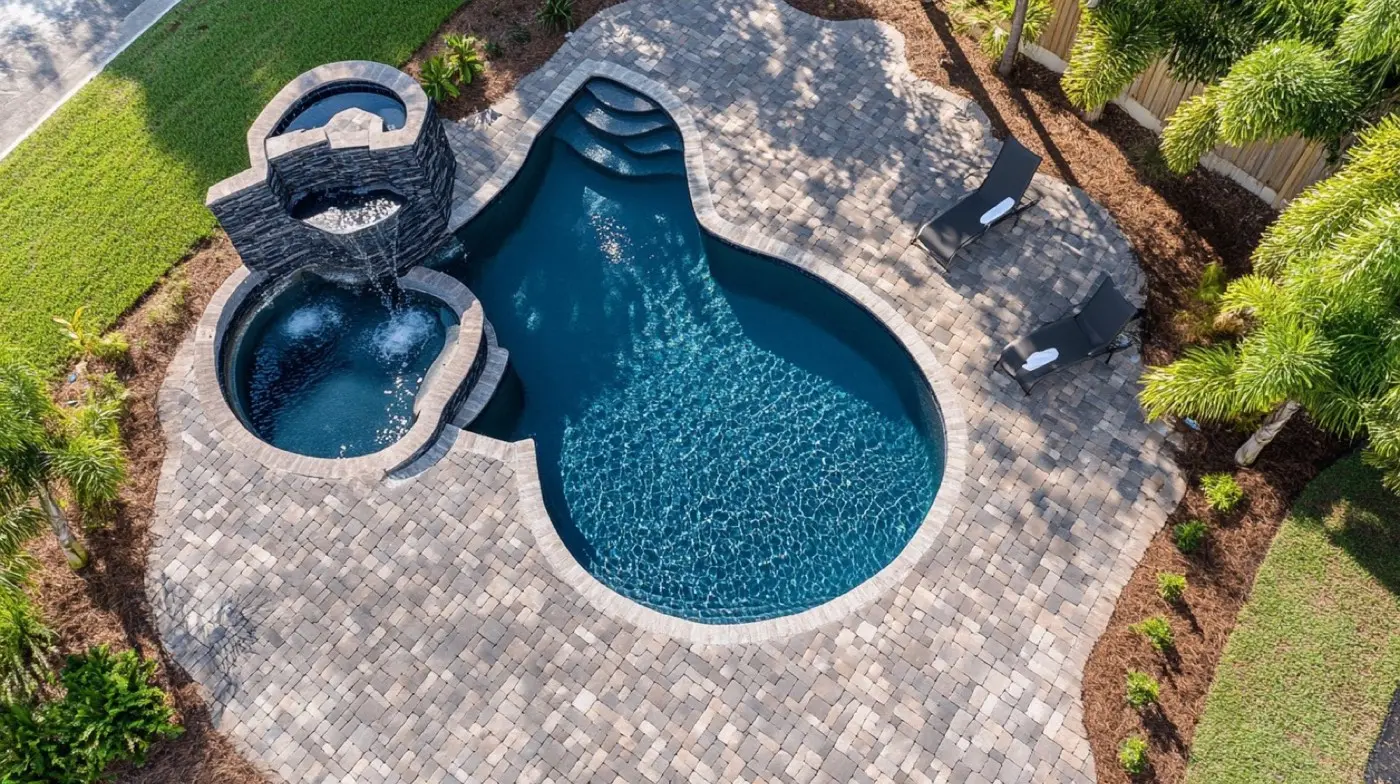
The best pool deck ideas for the South Carolina and Georgia Lowcountry start with a paver that stays cool underfoot, grips when wet, and shrugs off salt. Light travertine and shellstone run roughly 20–30°F cooler than gray concrete in summer sun, porcelain is essentially immune to salt and chlorine (water absorption ≤ 0.5%), and tumbled or textured finishes hit the wet-area slip target (DCOF ≥ 0.60). Below are 12 ideas — from a full travertine surround to tanning-ledge decks, raised spas, and permeable, self-draining layouts — each with a note on what makes it last on the coast. Pool decks run $28–$45 per square foot from uninsured and unlicensed installers; $60–$110 per square foot from a licensed, bonded and insured contractor with a workmanship guarantee, plus roughly $40–$75 per linear foot for coping (material and profile dependent).
How to Choose a Pool Deck That Survives the Lowcountry
Almost every "pool deck ideas" article online is written for a generic backyard — it lists pretty pictures and moves on. Here on the coast the deck has three enemies those articles never mention: relentless summer sun, constant water, and salt (both in the air and, increasingly, in the pool itself). After building pool decks from Mount Pleasant to Hilton Head to Savannah, we steer every one of them by the same three questions before we ever talk about looks.
Will it stay cool underfoot? Standard gray concrete stores solar heat and turns painful barefoot by midday. Light-colored travertine, shellstone, and porcelain reflect more sun and don’t bake the same way — installers who measure both on a hot afternoon commonly see travertine around 110–120°F versus concrete at 130–140°F, roughly 20–30°F cooler. Under a Lowcountry July sun, that is the difference between a deck you use at noon and one you only cross at a sprint. (Treat those as field readings, not a lab certificate, but the gap is real and consistent.)
Will it grip when wet? A pool deck is wet by definition, so traction is a safety decision, not a style one. The industry target for wet areas is a dynamic coefficient of friction (DCOF) of 0.60 or higher, and tumbled or textured travertine and shellstone clear it comfortably. The trap is finish, not material: honed or polished stone under a glossy sealer gets dangerously slick. We spec tumbled or textured field pavers and matte, penetrating sealers around water.
Will it stand up to salt? Two salt exposures hit a coastal deck — the ocean air and, on more and more homes, a saltwater chlorine-generator pool. Porcelain wins here outright: its water absorption is ≤ 0.5% (that’s literally the definition of porcelain), so salt and chlorine can’t etch, stain, or spall it, and it never needs sealing. Travertine and other natural stone work beautifully but are porous — spec them at 3% absorption or less and seal them, or salt will wick in, dry, and leave a white efflorescent haze.
Drainage and Base Prep — Where Coastal Pool Decks Live or Die
The deck has to move water away from the pool and the house — fast. Splash-out plus a Lowcountry afternoon downpour is a lot of water on a flat lot. The fixes are a proper pitch away from the pool and foundation (roughly a 1–2% slope), channel or trench drains at the deck perimeter where grade won’t do it alone, and — on flood-conscious sites — a permeable paver system that infiltrates the water instead of sheeting it toward the back door. Standing water is what breeds algae, slick spots, and base washout.
Sandy soil and a high water table are exactly why segmental pavers beat poured concrete around a pool. Lowcountry ground shifts and sits low, and a rigid concrete slab poured over it tends to crack — sometimes within a few years. Pavers sit on a compacted crushed-stone base and bedding sand and interlock, so they flex with minor ground movement instead of cracking. If a section ever settles, we lift those pavers, re-level the base, and reset the same units — no jackhammer, no mismatched patch. That liftability also means easy access to pool plumbing and equipment lines later. (Base depth matters here; we break it down in how deep a paver base should be.)
One honest note on rules. In South Carolina, a pool deeper than 24 inches has to be enclosed by a barrier at least 48 inches high, and a permit and site plan are required in essentially every jurisdiction. Coastal towns and HOAs — Hilton Head, Bluffton, Beaufort communities — often layer on their own barrier, setback, or material rules. We handle the deck; check your local building department and HOA before you finalize a layout.
12 Pool Deck Ideas
1. Travertine Full Surround
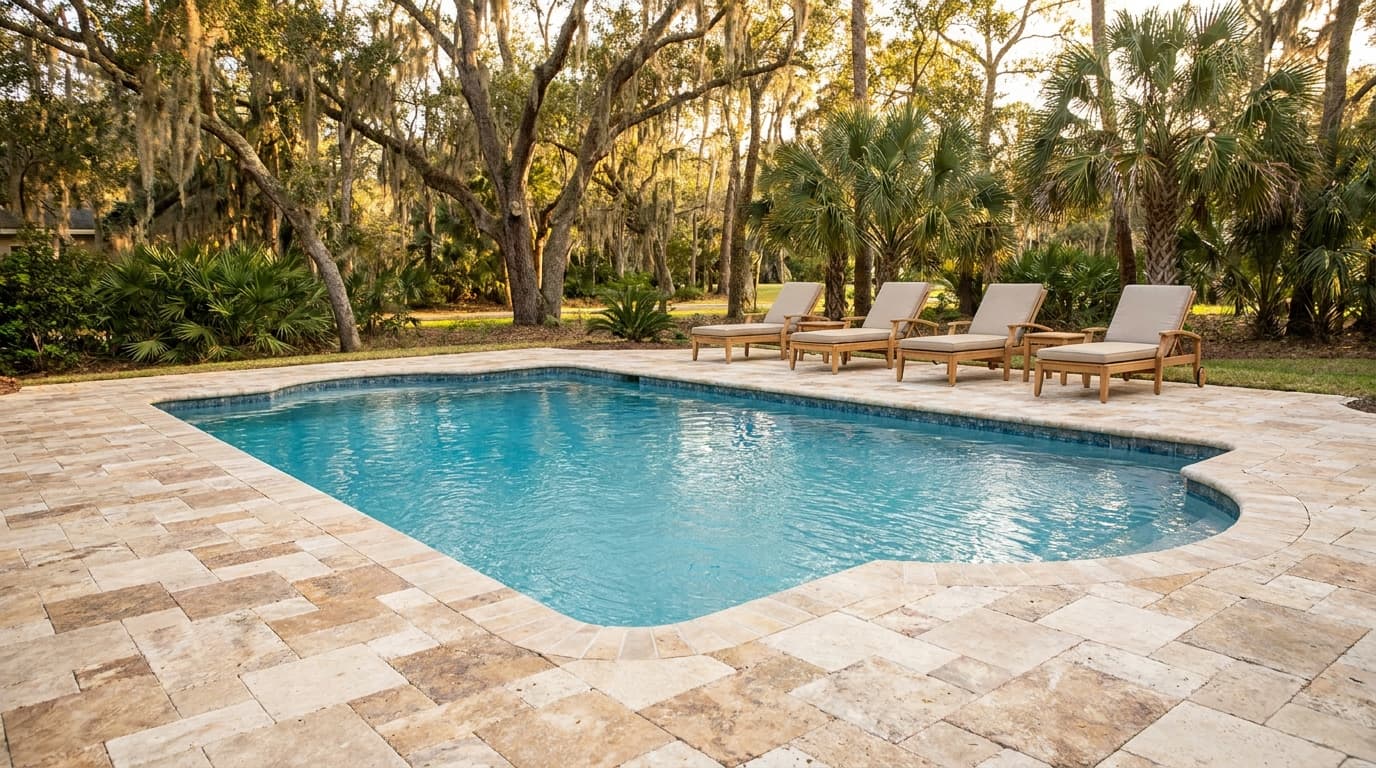
Wrap the entire pool in tumbled travertine for a soft, resort look that stays cool and grips underfoot. It is the most-requested pool deck stone in the country for good reason — a warm, natural palette that pairs with almost any home.
Lowcountry note: Stays roughly 20–30°F cooler than concrete under our sun, but seal it against saltwater and salt-air haze so it keeps its color.
2. Porcelain Paver Deck
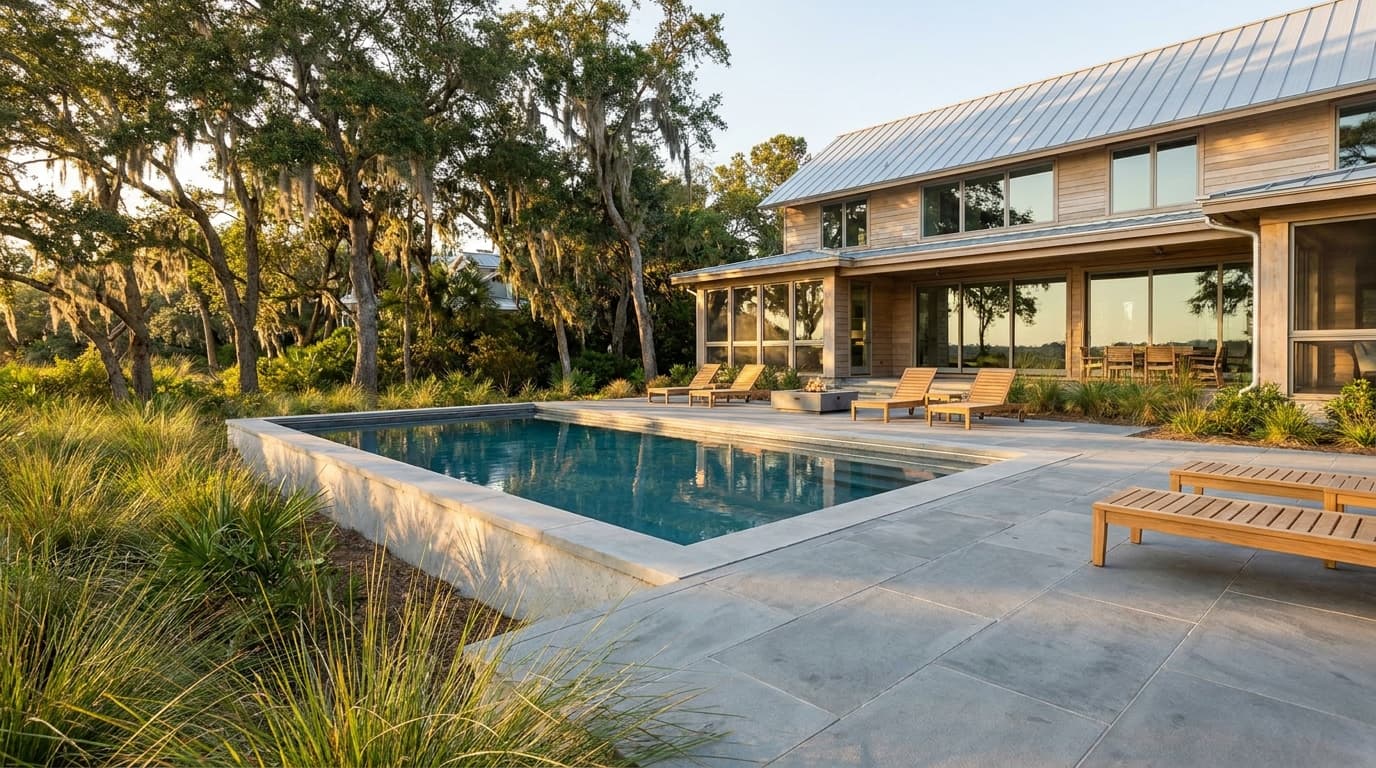
Large-format porcelain gives a clean, modern, low-maintenance surface in wood-look, stone-look, or concrete-look finishes. Thin, tight joints read contemporary and leave fewer places for weeds and washout.
Lowcountry note: At ≤ 0.5% water absorption, salt air and saltwater pools cannot etch or stain it — and it never needs sealing. The most maintenance-free coastal option.
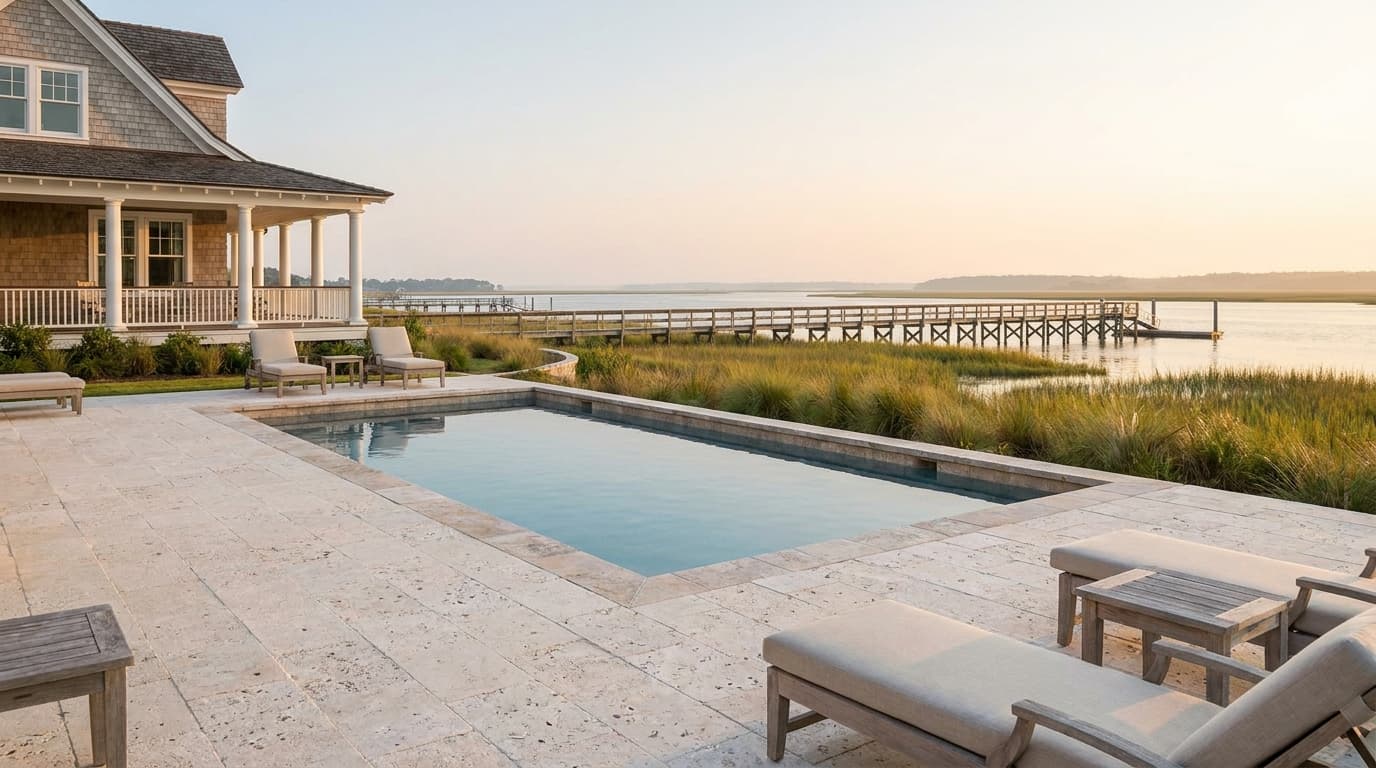
3. Shellstone & Tabby Coastal Deck
Oyster-shell-flecked shellstone and locally made tabby pavers put the Lowcountry coast right underfoot. Pale, textured, and unmistakably regional, they belong here in a way an imported stone never quite does.
Lowcountry note: The native material — naturally cool and slip-resistant, made for this climate. You will not find it on a single national pool deck listicle.
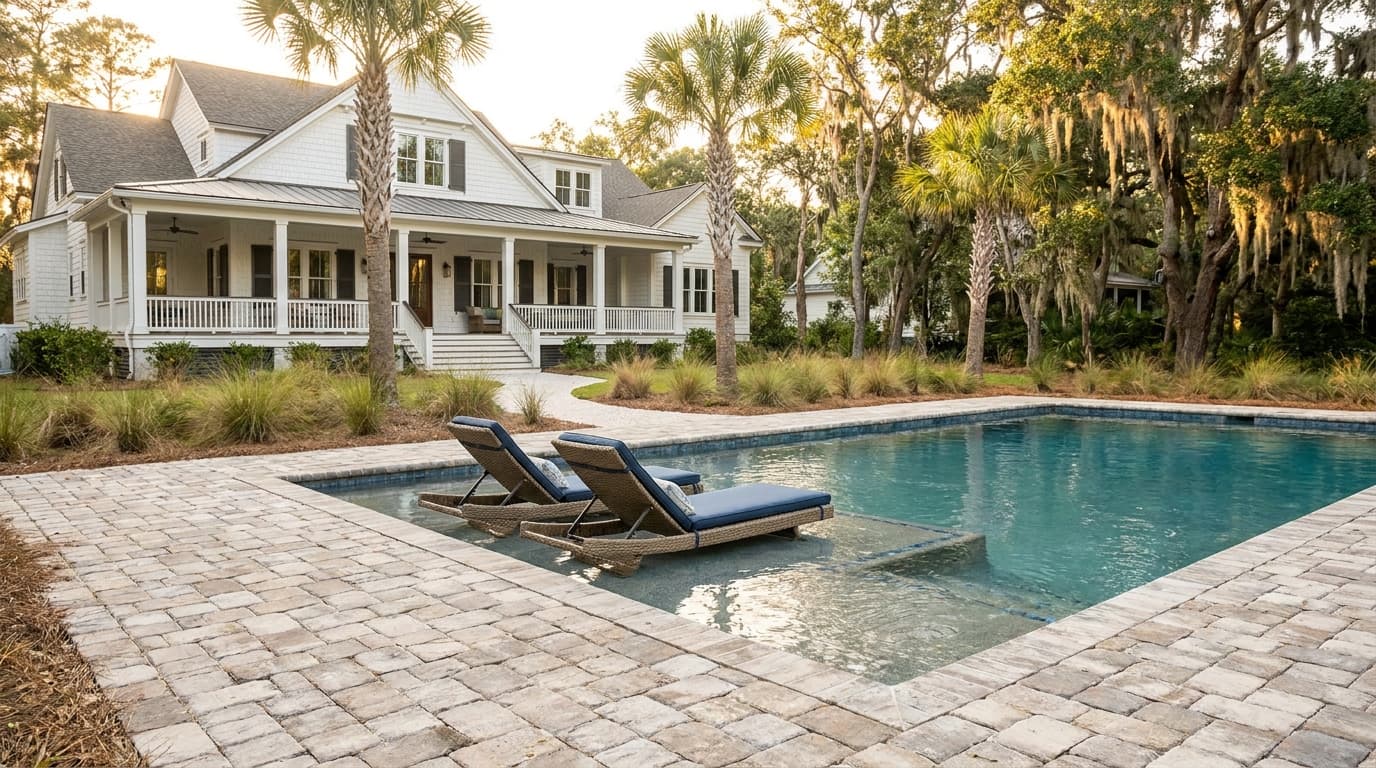
4. Tanning Ledge / Baja Shelf Deck
Carry the deck material into a shallow sun shelf so you can lounge half-submerged. Matching coping and field pavers make the in-water surface read as one seamless design.
Lowcountry note: This zone is always wet, so we use tumbled or textured pavers rated for wet traction (DCOF ≥ 0.60) — grip matters most exactly where the water sits.
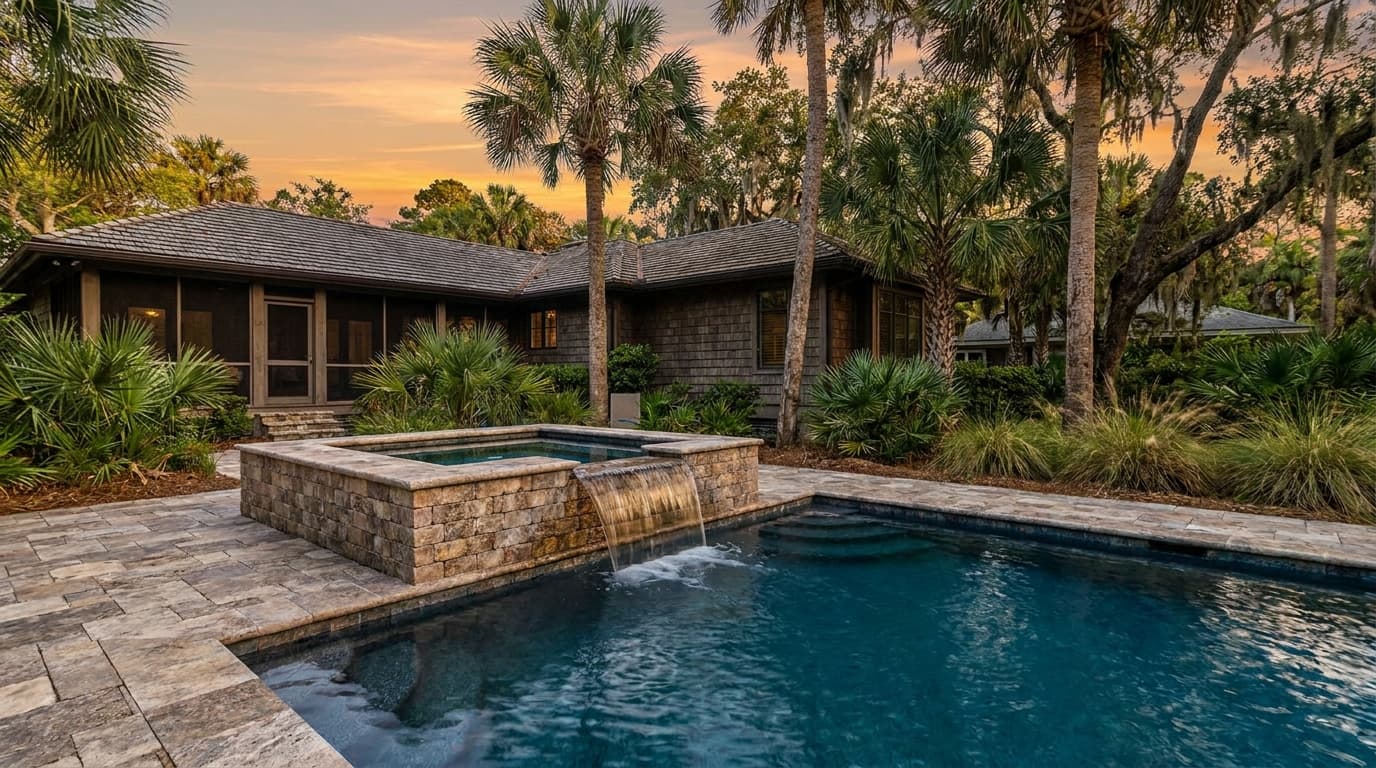
5. Raised Spa Surround
A raised spa that spills over into the pool, clad in matching coping and paver skirting. It adds a warm-weather soak and a focal water feature that ties the whole deck together.
Lowcountry note: Because the surround is segmental pavers, we can pull units to reach spa plumbing years later without demolishing the deck.
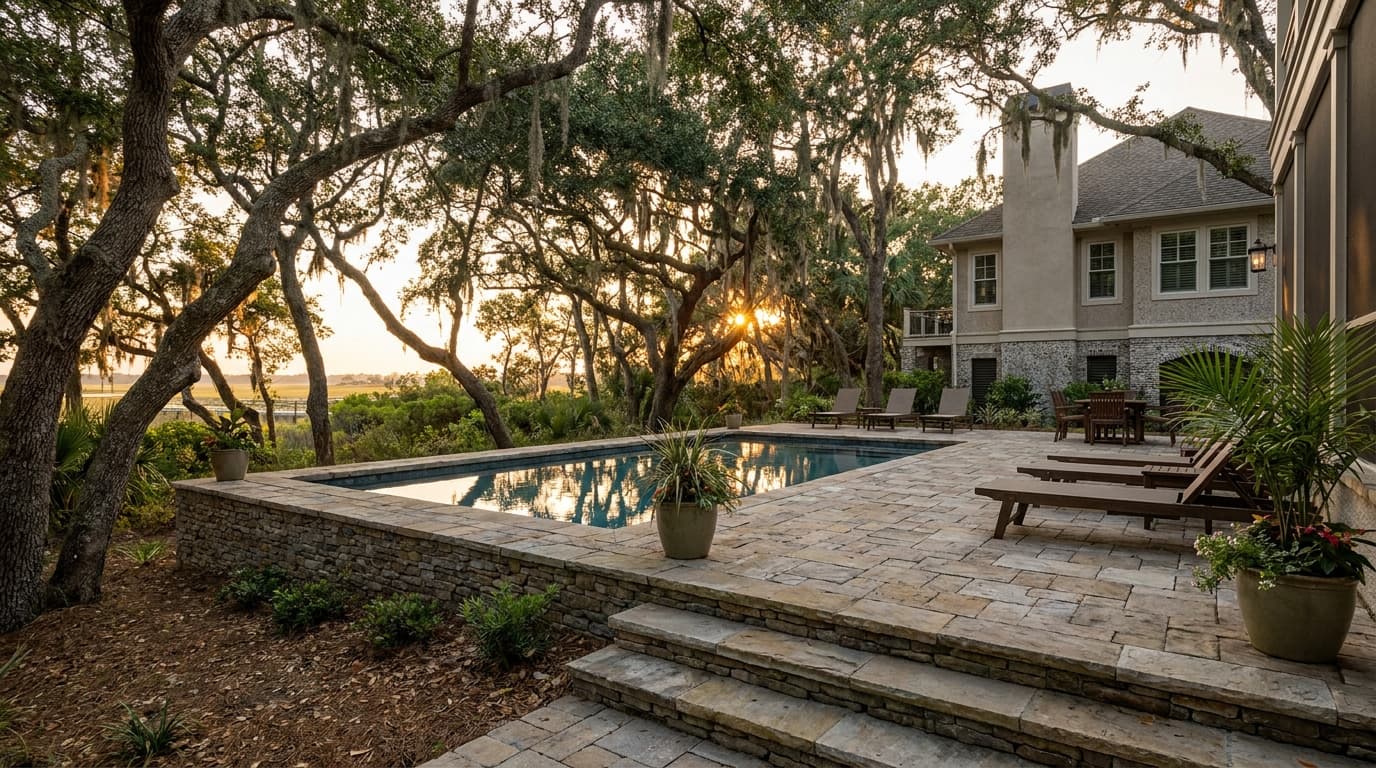
6. Multi-Level Deck
Step the deck across grade changes with paver stairs and low retaining walls to define lounge, dining, and pool zones. It brings architecture to a flat yard and makes a sloped or waterfront lot usable.
Lowcountry note: The retaining walls double as grade control, steering runoff away from the pool and the house on our low, flat lots.
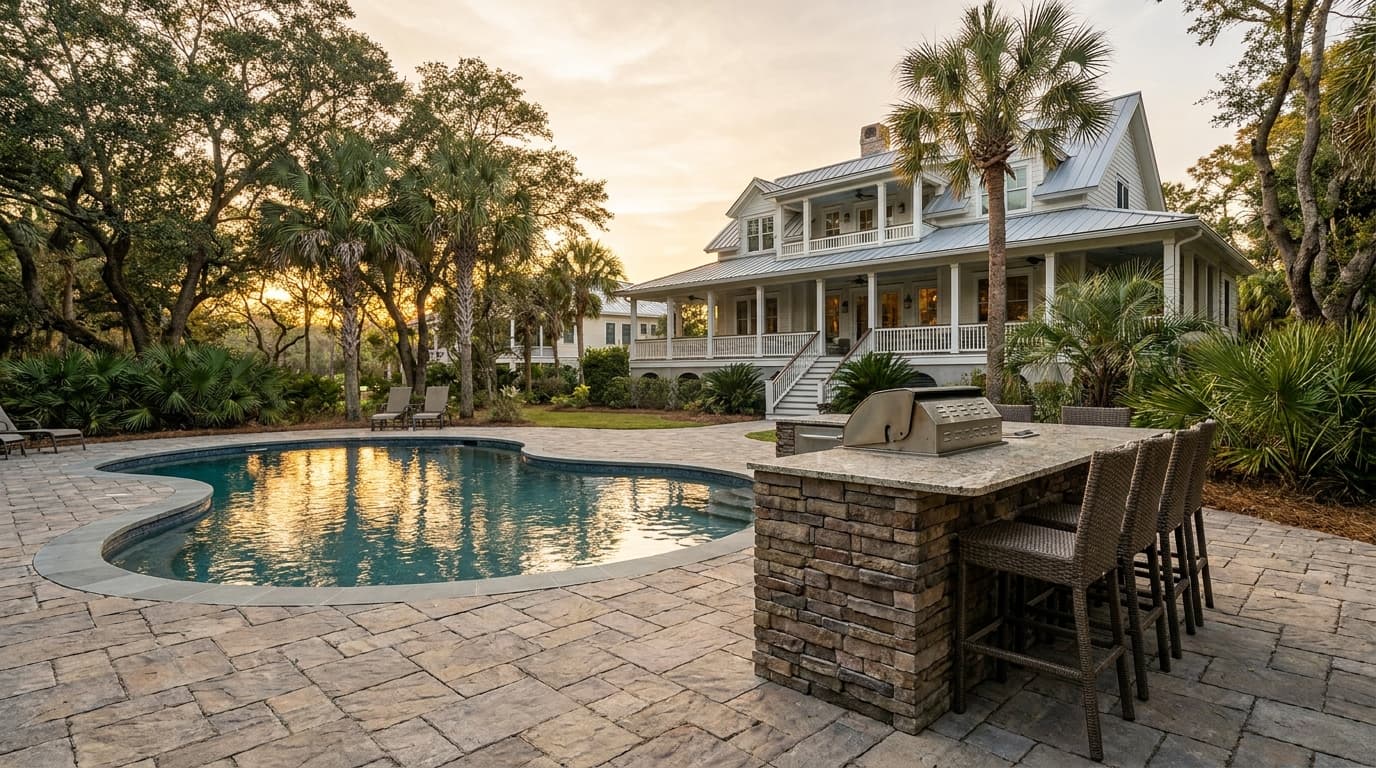
7. Pool + Outdoor Kitchen Combo
Anchor one side of the deck with a paver-based [outdoor kitchen](/outdoor-kitchen/) and bar seating. It turns the pool into a full entertaining space where nobody has to run inside for food or drinks.
Lowcountry note: Outdoor kitchens are one of the highest cost-recovery outdoor upgrades — the NAR pegs recovery near 100%. See our outdoor kitchen cost guide for real numbers.
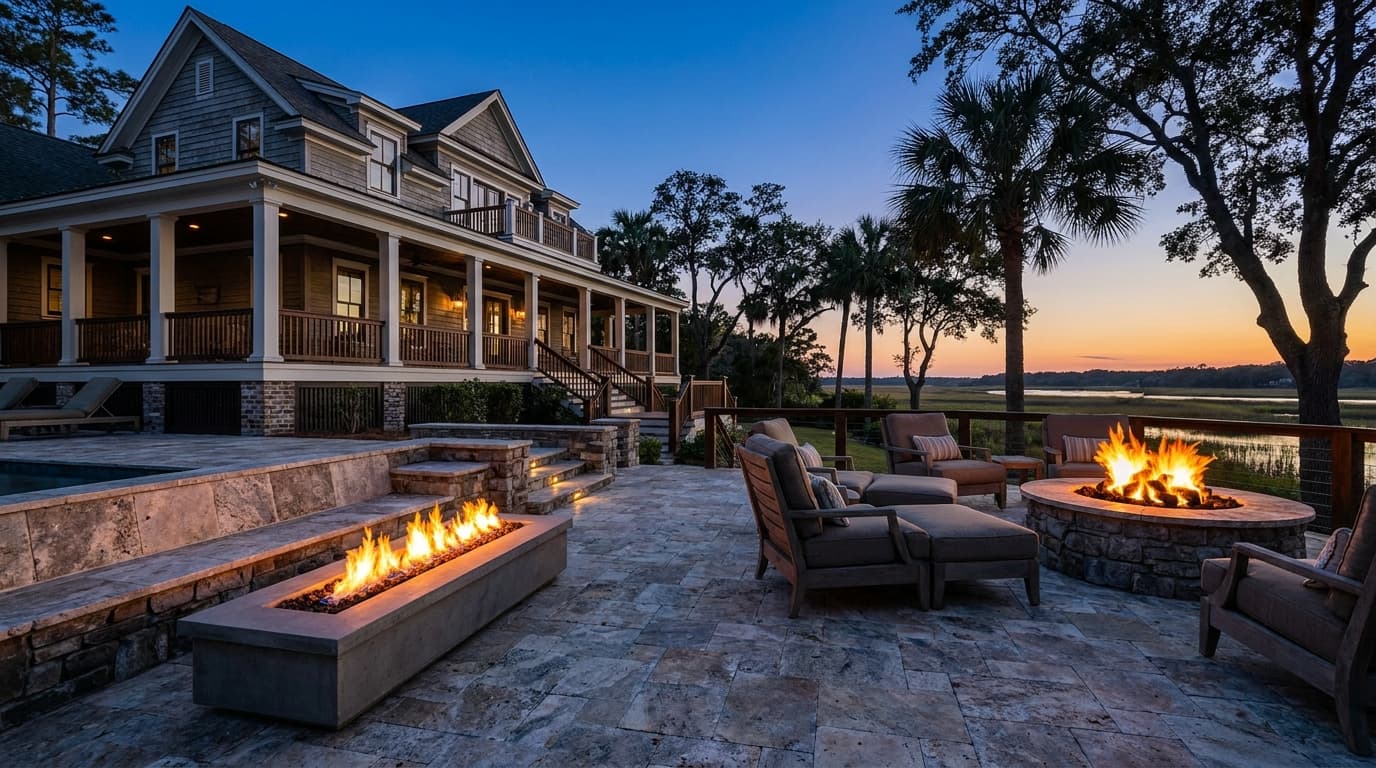
8. Fire Feature Deck
Add a [paver fire pit](/paver-fire-pit/) or a linear fire table at the deck edge for cooler evenings. A contrasting stone ties the feature back to the coping and gives the space a natural gathering point.
Lowcountry note: Our shoulder seasons are just cool enough that a fire feature stretches the usable deck season well past summer.
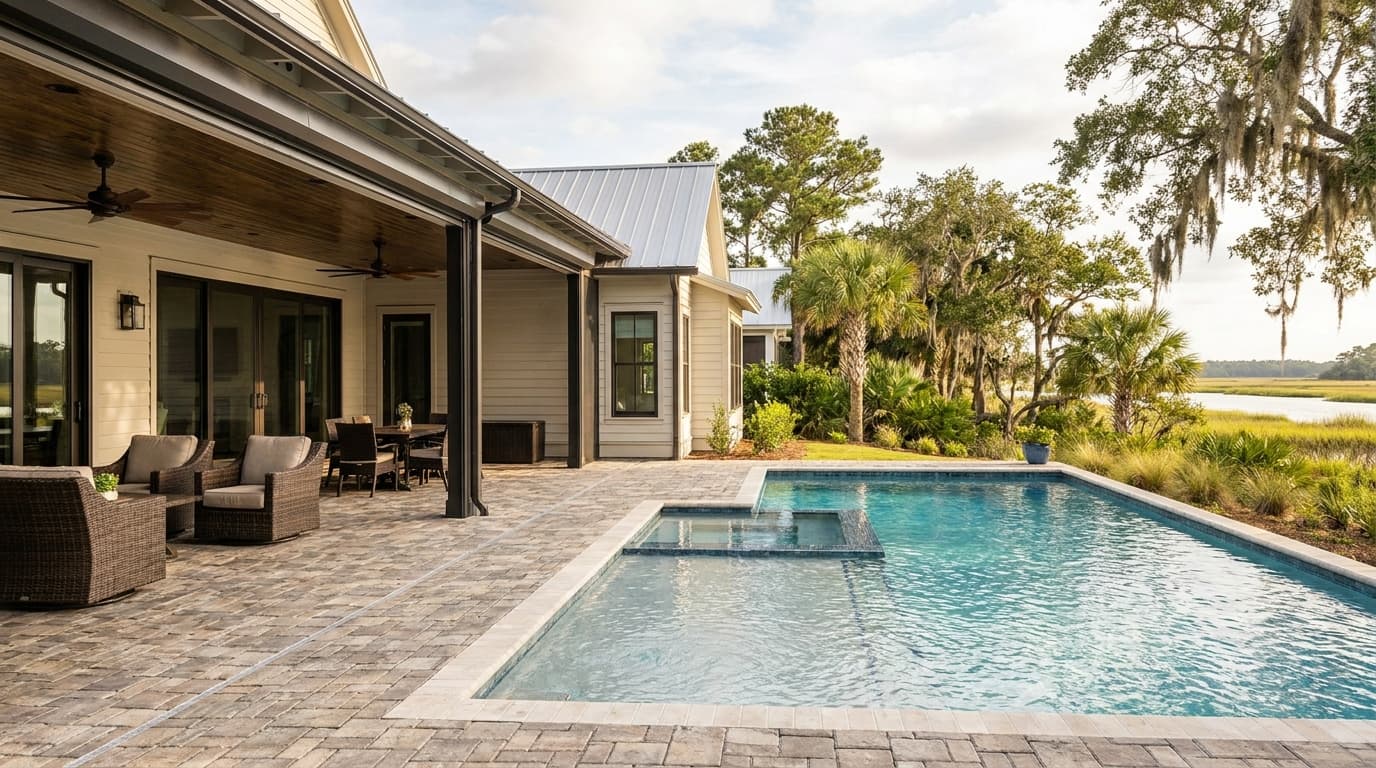
9. Screened Lanai / Covered Deck
Bring the paver surface under a screened lanai or covered porch for shade and bug-free lounging. It blurs the line between indoor and outdoor living and protects furniture from constant UV.
Lowcountry note: Shade plus screening is a Lowcountry staple against the sun and the no-see-ums, and pavers handle the humidity underfoot far better than wood.
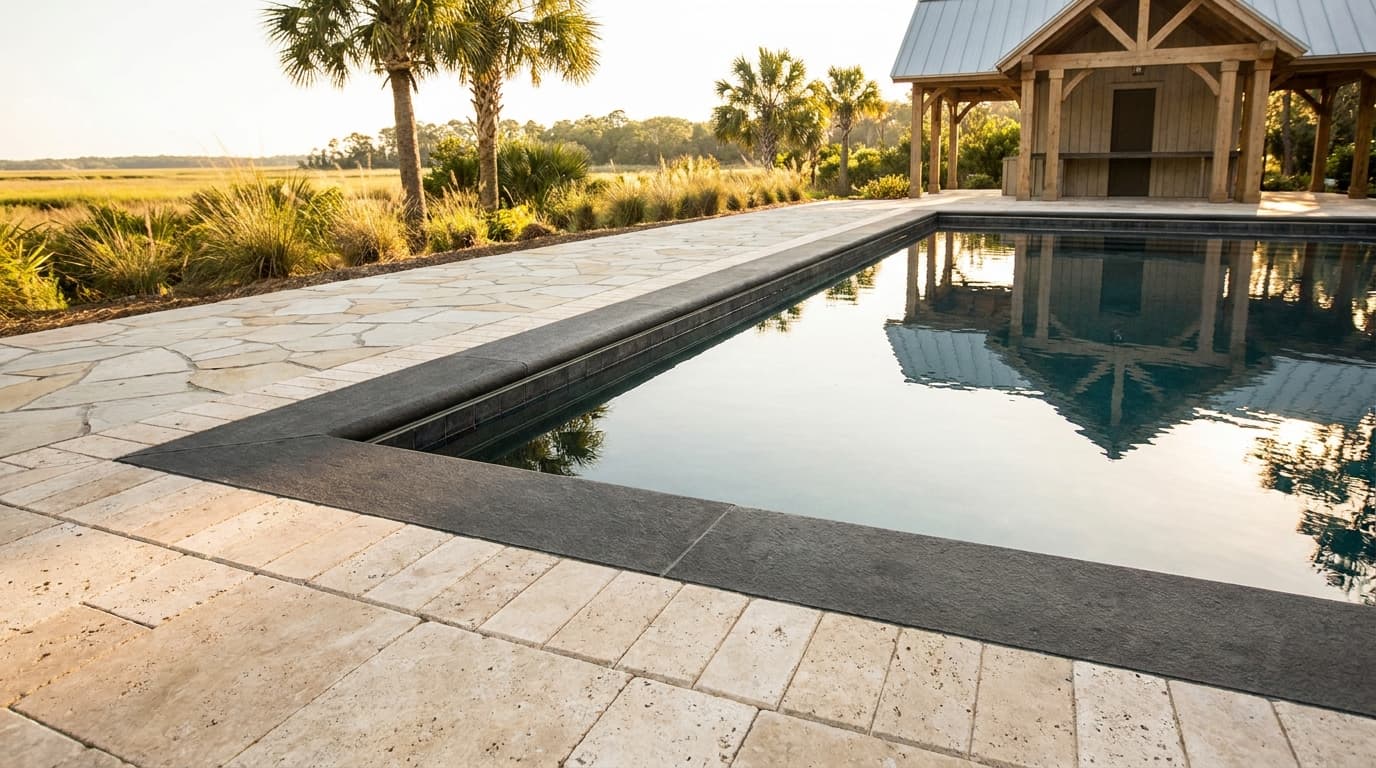
10. Contrasting Coping & Border
Frame the pool and the deck perimeter with a contrasting coping and a soldier-course border. It sharpens the entire design for very little added cost and makes the deck read as custom.
Lowcountry note: A bullnose coping gives a softer, safer wet edge to grab — the cheapest upgrade that also improves poolside safety.
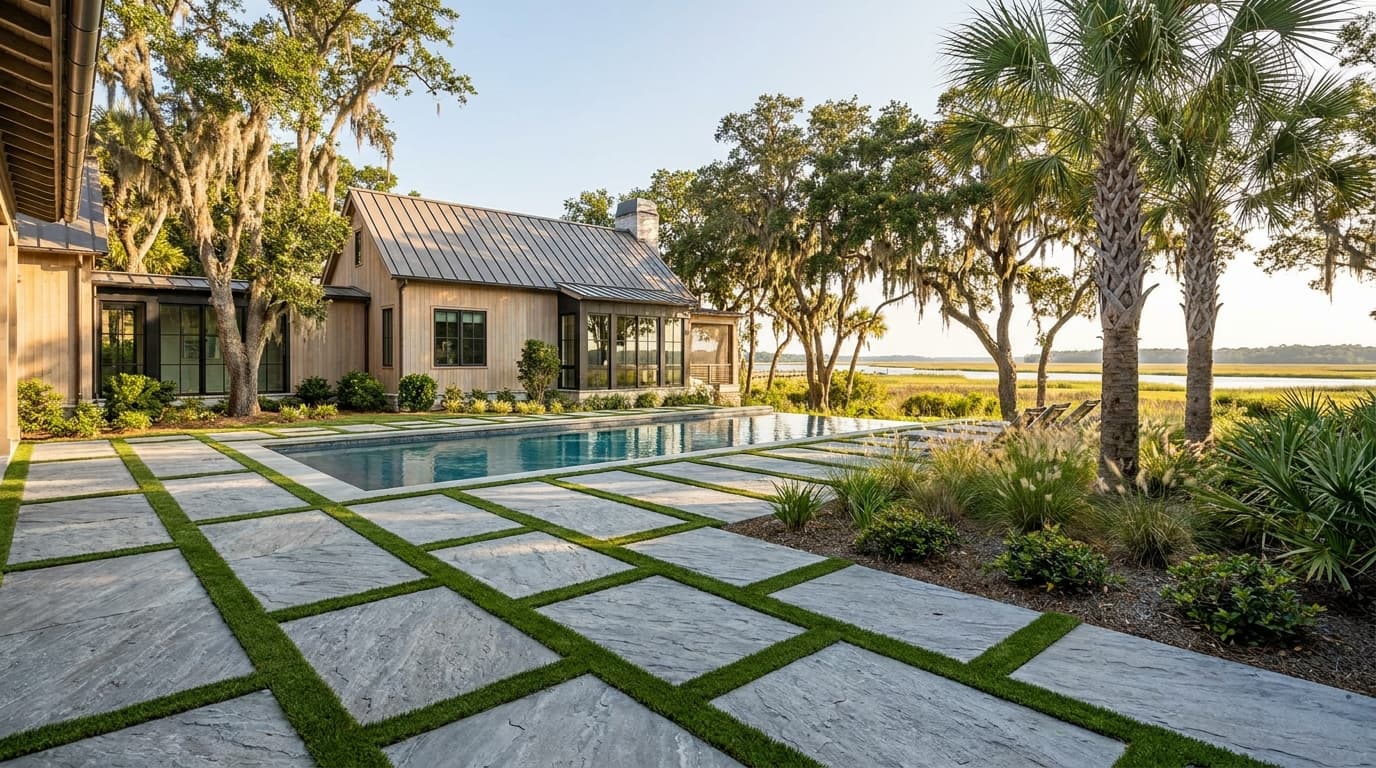
11. Paver + Turf Mixed Deck
Inlay [artificial turf](/artificial-turf/) or grass strips between large-format pavers for a modern, green, free-draining look. The soft green breaks up the hardscape and keeps the deck from feeling like a slab.
Lowcountry note: The open joints add real drainage capacity for heavy coastal rain, and the turf stays green through summer watering restrictions.
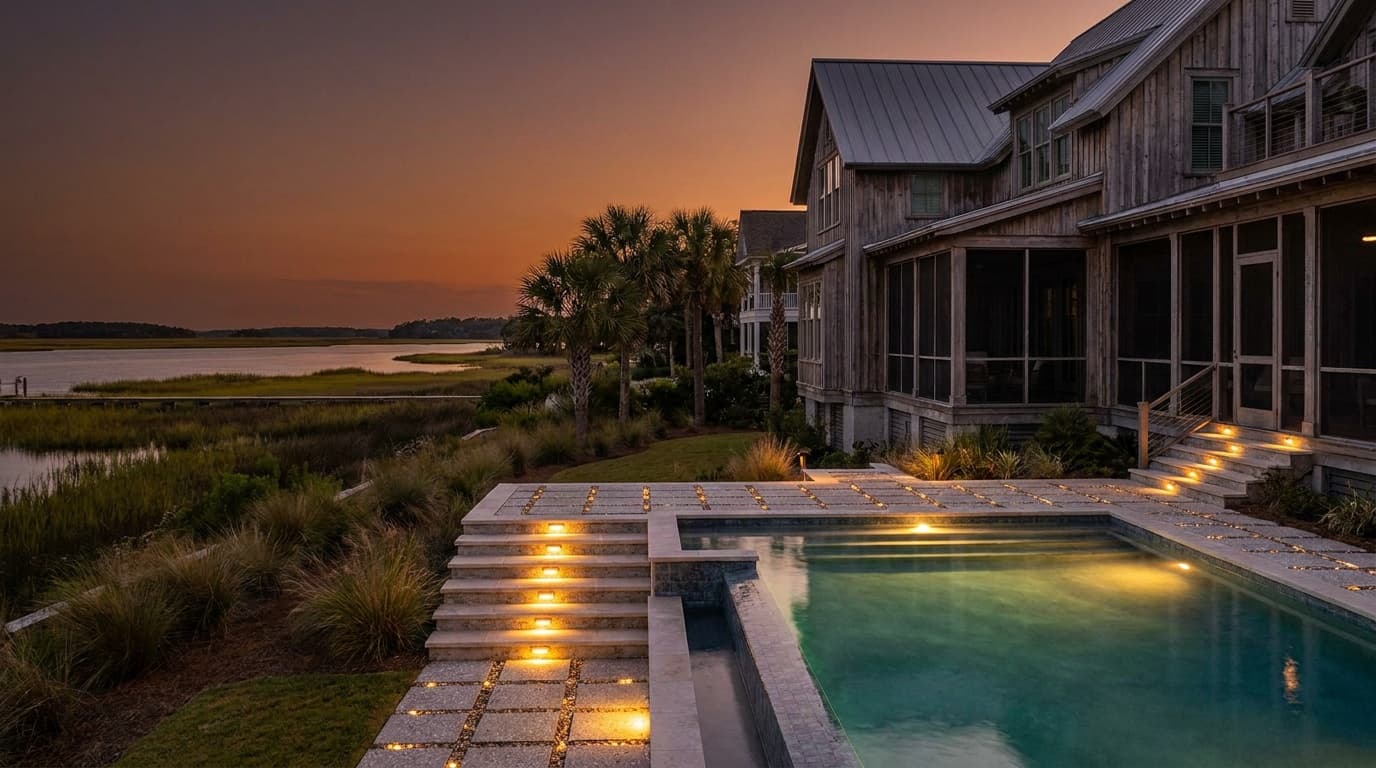
12. Permeable + Lit Deck
Combine a permeable paver system with integrated in-paver and step lighting for a deck that drains itself and glows at night. Function and ambiance in one build.
Lowcountry note: The permeable base infiltrates downpours instead of sending them toward the house, and low-voltage lighting makes a wet deck safer after dark.
What a Paver Pool Deck Costs — and What It Returns
Pool decks run $28–$45 per square foot from uninsured and unlicensed installers; $60–$110 per square foot from a licensed, bonded and insured contractor with a workmanship guarantee. Material still moves the number: standard concrete pavers sit at the low end, while travertine, porcelain, and premium natural stone climb from there. Add $40–$75 per linear foot for coping (material and profile dependent). A typical pool surround runs 600–900 square feet, which puts full decks well into five figures before drainage correction and features.
On value, be honest about what a pool is: mostly a lifestyle investment. In the National Association of Realtors’ 2023 Remodeling Impact: Outdoor Features report, an in-ground pool recovered about 56% of its cost at resale but earned the report’s top Joy Score of 10 — people love them, even if they don’t fully pay back. The deck itself carries stronger numbers: an outdoor kitchen recovered close to 100%, and an overall landscape upgrade about 100%. Pavers also tend to last 30 to 50 years or more and can be lifted and reset if soil moves, versus roughly 15 to 30 years for poured concrete that cracks sooner in wet, sandy ground. For how the two materials compare head to head, see our pavers vs concrete breakdown.
Plan Your Pool Deck
Related Reading
Frequently Asked Questions
Do pavers get hot around a pool?
Some do, but material and color decide it. Light travertine, porcelain, and shellstone run far cooler than gray concrete — installers commonly measure travertine around 110–120°F versus concrete at 130–140°F on a hot afternoon, roughly 20–30°F cooler underfoot.
What are the best pavers for a pool deck?
Travertine (cool and classic), porcelain (salt- and chlorine-proof, low maintenance), and — on the coast — shellstone or tabby all lead. Whatever the material, choose a tumbled or textured finish for wet-deck grip rather than a honed or polished one.
Are pavers slippery when wet?
Textured and tumbled pavers meet the wet-area target of DCOF 0.60 or higher and stay grippy underfoot. Honed or polished stone with a glossy sealer is what gets slick — the finish matters more than the material.
Are pavers good for a saltwater pool?
Yes, if you match the material. Porcelain has water absorption of 0.5% or less, so it is essentially immune to salt and chlorine. Travertine and natural stone work well too but should be sealed with a penetrating sealer to prevent salt haze in a saltwater or coastal setting.
Pavers vs. concrete for a pool deck — which is better?
Pavers cost more upfront but last longer, resist cracking on shifting coastal soil, and can be lifted and reset if settling occurs. Poured concrete tends to crack in wet, sandy ground and usually requires slab replacement rather than a spot repair.
How much does a paver pool deck cost?
Uninsured and unlicensed installers quote pool decks at $28–$45 per square foot; a licensed, bonded and insured contractor offering a workmanship guarantee will generally be $60–$110 per square foot, plus about $40–$75 per linear foot for coping. A full 600–900 square foot surround runs well into five figures once coping, drainage correction, and features are included.
How much space do I need around a pool?
Plan at least 3 feet of clearance on all sides, and ideally 4–6 feet where you want furniture and easy circulation. That commonly works out to 600–900 square feet of total deck for a typical residential pool.
How long does a paver pool deck last?
Quality pavers commonly last 30 to 50 years or more with basic upkeep, and individual units can be replaced or reset if needed. That is considerably longer service than poured concrete tends to give in a wet, shifting coastal climate.
Found an idea you love?
We will walk your site, talk through what holds up in your specific spot of the Lowcountry, and put a real number on paper. Free on-site assessment, no obligation.