The honest answer
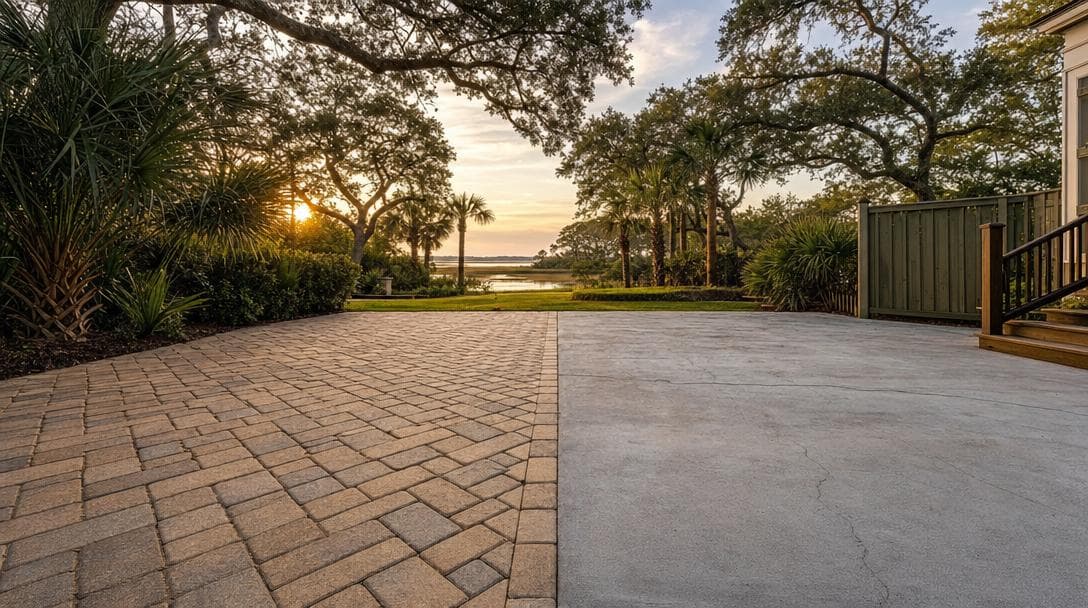
Pavers cost more upfront — a professionally installed paver driveway runs $50–$100 per square foot versus $6–$15 per square foot for poured concrete — but they last twice as long, repair without scars, and add measurably more resale value. You will also see paver quotes at $22–$40 per square foot; in our experience those come from uninsured, unlicensed installers without a workmanship guarantee. Concrete is cheaper today and faster to install, and for some applications it is still the right call. Below is the breakdown we give homeowners in Charleston, Bluffton, and Beaufort every week.
Pavers vs Poured Concrete: Side by Side
| Dimension | Pavers | Concrete | Winner |
|---|---|---|---|
| Installed cost (per sq ft) | $15 – $30 | $6 – $15 | Concrete |
| Realistic lifespan | 30 – 50+ years | 15 – 25 years | Pavers |
| Crack resistance | Excellent (flexible joints) | Poor (rigid slab) | Pavers |
| Repair experience | Lift and replace individual stones | Patch is always visible; full replacement to look right | Pavers |
| Design flexibility | Hundreds of colors, patterns, shapes | Gray (or stamped/colored at extra cost) | Pavers |
| Coastal SC durability | Tolerates soil shift, salt, humidity | Vulnerable to settling and salt scaling | Pavers |
| Installation time | 5 – 10 days (usable immediately) | 2 – 4 days (cure 7+ days) | Concrete |
| Maintenance | Re-sand joints every 3–5 yrs; optional seal | Reseal every 2–3 yrs; patch cracks | Tie |
| Resale value boost | Typically 70–80% ROI; strong curb appeal | Modest; treated as a baseline feature | Pavers |
| Warranty (ours) | 10 years on installation | N/A — we do not pour slabs | Pavers |
The Real Cost Difference (And What It Buys You)
On paper, concrete wins this round. A 400 sq ft poured patio in Charleston runs $2,400–$6,000 installed. The same patio in pavers runs $14,000–$26,000 professionally installed by a licensed, bonded and insured contractor. That is a real gap, and we will never tell a homeowner the gap is not there — what we will tell you is what the extra buys: a repairable surface, correct base and drainage for coastal soils, and a 10-year workmanship warranty.
But cost-per-year-of-use tells a different story. A concrete patio that lasts 18 years costs roughly $222 per year. A paver patio that lasts 40 years costs roughly $225 per year — and looks better the entire time. The "expensive" option is essentially flat once you amortize it, and that math ignores resale value entirely.
Where concrete genuinely wins on cost is unfinished spaces you do not care about visually: a side-yard utility pad, a shed foundation, a basic walkway between buildings. For anything you will actually look at or sit on, paver economics catch up fast.
Cracks Are Inevitable in Concrete — That Is the Whole Story
Concrete is a rigid slab. The Lowcountry has clay soil, high water tables, root pressure from live oaks, and tropical storm flooding. Every one of those forces moves the ground under a slab, and the slab has no way to absorb that movement. It cracks. It does not crack because your contractor was bad; it cracks because that is what concrete does on this geology, on this timeline.
Pavers solve the problem by being many small units sitting on a flexible compacted base with sand-filled joints. When the ground shifts, the joints absorb it. When one paver is damaged by a dropped grill or a tree root, you pull it up and drop a new one in. The repair is invisible. Concrete repair, by contrast, is always visible — patched concrete is patched concrete, and refinishing a slab almost never matches.
Coastal Lowcountry: Why This Comparison Is Different Here
We install in Charleston, Bluffton, Beaufort, Savannah, and across the SC and GA coast. The local conditions matter:
Salt air accelerates surface scaling on concrete, especially within a mile of the marsh. Pavers are individually manufactured with sealers and are far more resistant.
Hurricane substrate movement is a real risk every 3–5 years. Slabs that survived the last storm are not guaranteed to survive the next one. Flexible paver systems flex and re-settle.
Live oak and palmetto root systems lift slabs by inches over a decade. Pavers can be lifted and reset over the affected area in a single morning.
Pool deck applications introduce constant pool chemistry exposure. Concrete spalls; pavers do not.
Which Wins By Application
Patios
PaversFor a patio you will live on — grill, fire pit, outdoor furniture, kids and dogs — pavers are the right call almost every time. The visual upgrade alone justifies the cost gap, and repair experience over a 20-year ownership window is dramatically better.
Aesthetics and repairability dominate this category.
Explore patios →Driveways
PaversVehicle loads, oil drips, and root pressure punish driveways. Concrete driveways in the Lowcountry crack within 10–15 years. Paver driveways outlast that by decades, and any compromised section can be lifted and reset without resurfacing the whole drive.
Repair without scars and longevity are decisive here.
Explore driveways →Pool Decks
PaversPool decks are the clearest case for pavers. Pool chemistry, constant wet/dry cycling, and bare feet (heat and slip) all favor pavers. Concrete pool decks spall, scale, and burn feet within the first few summers.
Texture, temperature, and chemistry resistance all favor pavers.
Explore pool decks →Utility pads & sheds
ConcreteFor a hidden equipment pad, AC condenser base, or shed foundation, concrete is almost always the right answer. You are not optimizing for looks, you do not need to repair it without scars, and the cost gap matters when the surface is hidden.
Invisible utility surfaces are where concrete wins outright.
Explore utility pads & sheds →When Pavers Wins
You plan to be in the home 7+ more years
Lifespan economics tilt hard toward pavers past year 7. If you are within a year of selling, the resale boost still favors pavers — but the lifespan math gets less decisive.
The surface is visible from the street or main living areas
Aesthetics drive resale appraisals. Pavers signal "finished outdoor living"; bare concrete signals "utility surface."
You are on coastal or shifting soil
Every property east of I-95 has some version of unstable substrate. Paver systems flex with the ground; slabs crack.
When Concrete Wins
We do not install concrete, but we will not pretend pavers are always the right call. Here is when they are not.
Strict budget, hidden surface
A side-yard equipment pad or basic utility walkway where no one will ever look — concrete is cheaper and good enough.
Very short timeline
If you need a usable surface within 48 hours and can afford the 7-day cure wait afterwards, concrete is faster to put down. Most paver installs take 5–10 days but are walkable immediately.
Bonded structural slab requirements
Some commercial loading docks, pole-barn floors, and engineered foundations specifically require a monolithic concrete pour. Pavers are not the right system for those.
Explore Our Paver Services
Related Reading
Other Material Comparisons
Frequently Asked Questions
Are pavers really worth twice the cost of concrete?
For visible, frequently-used surfaces — patios, driveways, pool decks — yes. The lifespan is roughly double, the repair experience is dramatically better, and the resale impact is measurable. For hidden utility surfaces, concrete is fine.
How long do pavers last in coastal South Carolina?
Properly installed paver systems regularly last 30–50+ years here. The base preparation matters far more than the paver itself; we excavate to 8 inches, install geotextile fabric, and compact a graded aggregate base in 2-inch lifts. That is what makes a paver system survive Lowcountry conditions.
Will my pavers shift, sink, or get weeds in the joints?
Settling and weeds are both base and joint-sand issues. A correctly prepared base prevents settling; modern polymeric joint sand prevents weeds for 5–10 years before any re-application is needed. Both problems are almost always installation mistakes, not paver problems.
Can pavers be installed over an existing concrete slab?
Sometimes — if the slab is sound, draining properly, and you have the height clearance at door thresholds. We assess this on-site. When a slab is already cracked or pumping, we will recommend a tear-out and proper base install, because building on a failing slab guarantees the same failure in the new surface.
How much does a paver driveway cost vs a concrete driveway?
For a standard 600 sq ft driveway in the Charleston area, expect $30,000–$60,000 for pavers professionally installed and $3,600–$9,000 for concrete. The paver driveway will outlast the concrete one by 2–3x, repair without scars, and significantly outperform on curb appeal. Lower paver quotes exist in this market — typically $22–$40 per square foot from uninsured, unlicensed installers — and the difference shows up in the base, not the surface.
Do pavers crack like concrete?
Individual pavers can crack from extreme impact (a dropped engine block, for instance), but the system as a whole does not crack the way a concrete slab does. That is the entire structural advantage of pavers — flexible joints absorb movement that would otherwise tear a slab.
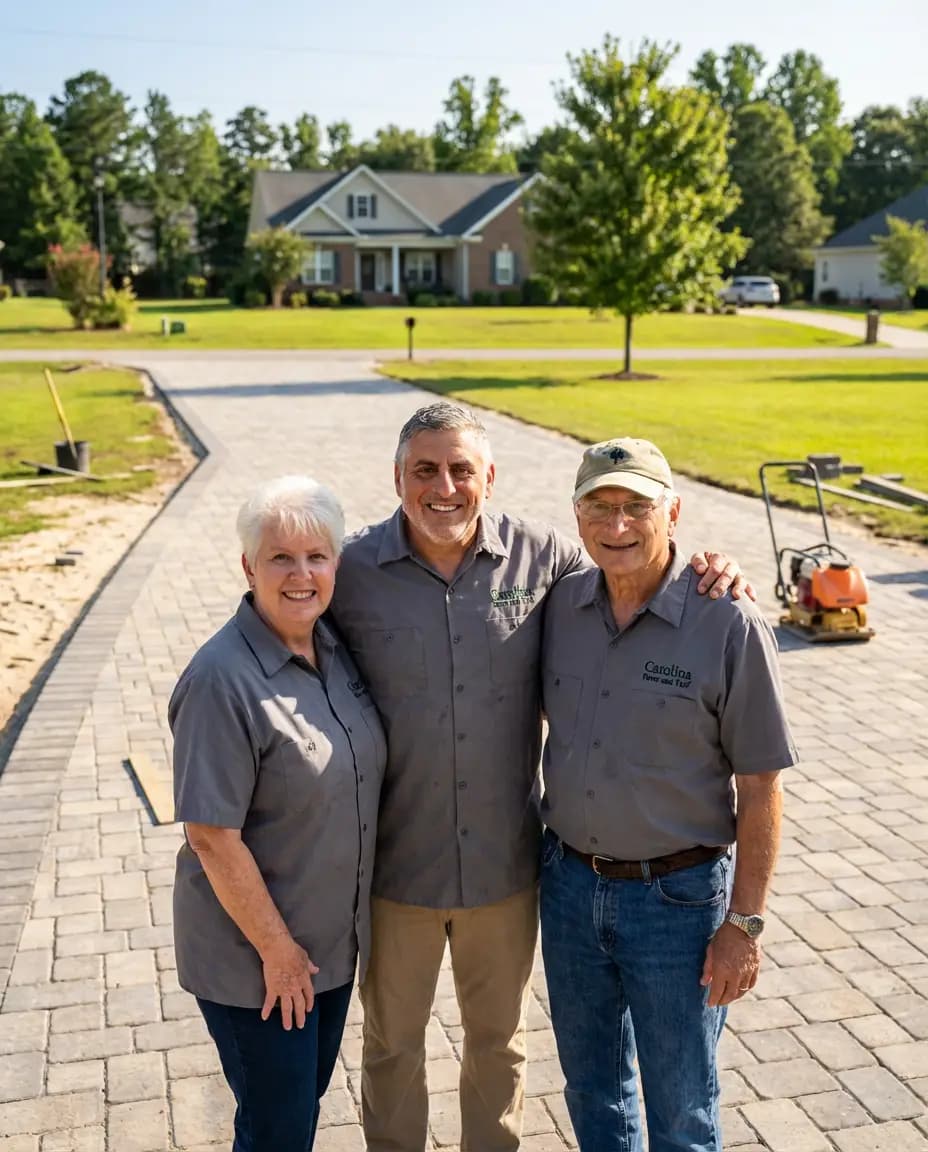
Owner, Carolina Paver & Turf
Michael Barbieri brings 10+ years of hardscape sales and construction experience, helping Lowcountry homeowners design patios, driveways, turf, and marine spaces built for coastal conditions.
Still deciding? Get a real quote.
Free on-site assessment, no obligation. We will tell you honestly whether pavers are the right call for your project, your timeline, and your budget.