
How Deep Should a Paver Base Be?
Paver base depth depends on your soil and traffic load, but a typical compacted aggregate base is about 4–6 inches for pedestrian patios and walkways and 8–12 inches for residential driveways, placed over a compacted subgrade. Heavy loads, weak or clay soils, poor drainage, or freeze-thaw all require a deeper, engineered base. There is no universal rule of thumb — and that is the whole point of this guide.
It is the most common question we get before a project starts, and the honest answer frustrates people who want a single number: it depends. A paver patio behind a Mount Pleasant home and a driveway that takes a loaded truck do not get the same base, and a base that lasts 30 years on firm sandy soil can fail in two on wet Lowcountry clay. What follows is how we — and the Concrete Masonry & Hardscapes Association (CMHA), North America’s authority on segmental pavement — actually decide.
The Layers: What a Paver Base Actually Is
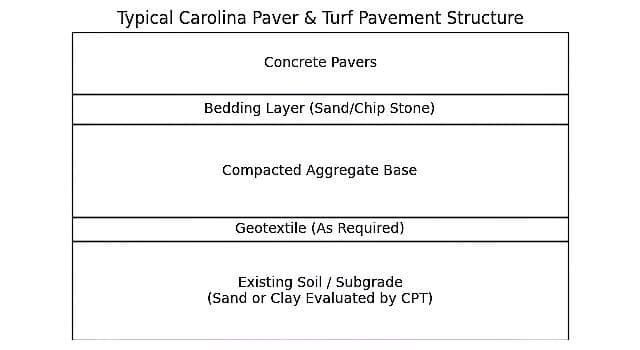
A paver surface is a flexible pavement — a system of layers, each with a job. From the top down:
- Pavers — the wearing surface (typically 60 mm for pedestrian, 80 mm for light-vehicular). Interlock transfers load sideways to neighboring units.
- Bedding layer — a uniform 1-inch course of washed concrete sand that the pavers set into. It is a setting bed, not a leveling layer, and should never exceed about 1.5 inches.
- Compacted aggregate base — dense-graded aggregate (crusher run / road base, 3/4 inch down to fines). This is the structural layer, and its depth is what this article is really about.
- Geotextile — a separation fabric used as needed over clay or soft soil to keep the subgrade from contaminating the base.
- Compacted subgrade — the native soil. Its strength drives every decision above it.
Base Depth by Application
| Application | Base (good soil) | Challenging conditions |
|---|---|---|
| Patio / walkway (pedestrian) | 4 in. minimum | 4–6 in. |
| Residential driveway | 6 in. minimum | 8–12 in. |
| Parking / residential street | 8 in. minimum | 8–12 in. |
| Heavy-duty / commercial | 12 in.+ — engineered to the load | |
Loads matter because pavers spread concentrated weight across the soil below. A heavier load means more stress on the subgrade, so you need a thicker base to keep that stress within what the soil can take. That is why a paver driveway always gets a deeper base than a paver patio.
Soil Is the Most Important Factor
Here is the rule that ties the whole article together. CMHA advises starting from the minimum base depth and adding roughly 50% for each missing “optimum condition” — good soil strength, good drainage, and no freeze-thaw. A driveway that lacks all three can need around 15 inches of base instead of 6. So the same driveway needs very different bases depending on what it sits on.
This is exactly why the Lowcountry is tricky. Our region serves up both extremes: loose, well-draining marine sand in some yards and heavy, expansive clay fill in others, often with a high water table close to the surface. Sandy soil drains beautifully but offers little structural support; clay holds water, swells and shrinks, and can pump fines up into the base. A base spec that works in dry, firm soil elsewhere will sink here — which is why we evaluate every site rather than quoting a fixed depth over the phone.
Compaction: Why “In Lifts” Matters
A base is only as good as its compaction. A plate compactor can fully densify roughly the top 2 to 4 inches of stone at a time, so a crew that dumps 10 inches of aggregate and runs the plate over it once leaves the bottom loose — and that loose layer consolidates later, sinking the surface with it. Done right, the base goes in and gets compacted in lifts of about 2 to 4 inches (never more than 4–6), each one compacted before the next is added, targeting at least 95% standard Proctor density. The subgrade gets compacted first, too.
Geotextile vs. Geogrid
Two fabrics, two jobs. Geotextile is a separation fabric — laid over soft or clay subgrades, it keeps the soil’s fines from migrating up and contaminating the aggregate base. ICPI guidance recommends it over clay soils, which makes it close to standard practice on many Lowcountry lots. Geogrid is a reinforcement grid — it interlocks with the aggregate to confine and strengthen the base over weak soils or under heavy loads. Field and DOT studies credit geogrid with cutting rutting by 70 to 90% and extending service life several times over. On a difficult site we often use both: geotextile on the soil for separation, geogrid above it for reinforcement.
A Real Example: When 48 Inches Was the Right Answer
Early in my career in Seattle, I rebuilt a residential driveway that had failed under repeated garbage-truck traffic — roughly 30,000 pounds hitting the same path over and over. The original base had rutted and water had infiltrated underneath. The reconstruction used about 48 inches of crusher-run granite reinforced with geogrid and mechanized compaction.
That is far beyond any normal residential spec — and that is the point. The depth was engineered to an extreme, repeated, concentrated load over a weak, wet subgrade. It is not a number you would ever use for a typical driveway. But it is the clearest proof of the thesis: base depth is engineered to the load and the soil, not guessed. A base built for a sedan is not a base built for a truck hitting the same spot thousands of times.
The Mistakes That Cause Failure
- Too-thin base — under-built for the real load and soil, so it settles, ruts, and cracks.
- Skipping compaction — no lifts or an undersized compactor leaves the base loose, and it consolidates later.
- Over-thick bedding sand — using sand to fix a bad base; thick sand migrates under load and the pavers move with it.
- No edge restraint — pavers spread, joints open, and the interlock that makes the system work is lost.
- No geotextile over clay — fines pump up into the base and it fails from below.
- Ignoring drainage and grade — without a slope of about 1/8 to 1/4 inch per foot, water saturates the base. In the high-water-table Lowcountry that is often the first thing to fail. (More in our guide on why pavers sink.)
The base is the part of a paver project you never see and the part that decides whether it lasts. If you are weighing pavers against a poured slab, our pavers vs. concrete comparison covers the long game, and once your pavers are down, the right polymeric sand in the joints keeps everything locked together.
Frequently Asked Questions
How deep should a paver base be for a patio?
For a pedestrian patio or walkway over well-drained soil, plan on about 4 to 6 inches of compacted aggregate base (4 inches is the CMHA minimum) plus a uniform 1-inch bedding sand layer, all over a compacted subgrade. Weak or clay soils call for more.
How deep should a paver base be for a driveway?
A residential driveway typically needs about 8 to 12 inches of compacted aggregate base — 6 inches is the absolute CMHA minimum over ideal soil — plus a 1-inch bedding layer. Poor drainage, clay soil, or heavier vehicles push that depth higher.
What is the best base material for pavers?
Dense-graded aggregate — also called road base, crusher run, or DGA (roughly 3/4 inch down to fines, per ASTM D2940). Its angular particles and fines lock together when compacted. Avoid stone dust, river rock, and pea gravel, which do not provide a stable, load-bearing base.
Can you lay pavers on sand only?
No. Sand alone cannot carry load or resist erosion — it shifts and washes out, and the pavers sink and rut. Pavers need a compacted aggregate base beneath a thin (about 1 inch) sand bedding layer. The base does the structural work; the sand is only a setting bed.
How thick should bedding sand be under pavers?
A uniform 1 inch (25 mm), and never more than about 1.5 inches. The bedding layer is a setting bed, not a leveling course — using extra sand to smooth out a poor base lets the pavers move and rut under load. Fix the grade in the base, not the sand.
What happens if the paver base is too thin?
A too-thin base overstresses the soil beneath it. The pavers sink, rut, and crack, joints open up, and water begins to pool — leading to premature failure and a costly rebuild. The base is what spreads load and protects the subgrade, so under-building it is the most expensive shortcut there is.
Does soil type change how deep the base should be?
Yes — it is the single biggest factor. Weak or expansive clay needs a deeper base plus a geotextile separation fabric, while well-draining sandy soil needs less. CMHA recommends increasing the minimum base depth by roughly 50% for each missing optimum condition: weak soil, poor drainage, or freeze-thaw.
Do you really need gravel under pavers?
Yes, for any installation meant to last. A compacted aggregate (gravel) base spreads loads across the soil and provides a stable, draining foundation. Skipping it — laying pavers on sand or bare dirt — is the number-one cause of sinking, rutting, and early failure.
Owner, Carolina Paver & Turf
Michael Barbieri brings 10+ years of hardscape sales and construction experience, helping Lowcountry homeowners design patios, driveways, turf, and marine spaces built for coastal conditions.
Related Reading
Keep researching — these guides go deeper on what you read here.
Want a base built for your soil?
We evaluate the soil, drainage, and loading on every Lowcountry project and engineer the base accordingly. Free on-site assessment, no obligation.