
Permeable vs Dry-Set Pavers
Permeable and dry-set pavers differ in one fundamental way: where the water goes. Permeable pavers let stormwater drain through the surface into a stone reservoir below, where it infiltrates the ground. Dry-set (traditional) pavers shed water off the surface and rely on grading to carry it away. Choose based on drainage needs, soil, and budget.
People assume the difference is the joints — wider gaps on permeable pavers. That is the visible part, but the real difference is the entire structure underneath. One is built to shed water; the other is built to swallow it. On the flat, low-lying, high-water-table lots we work across the Lowcountry, that distinction decides whether a project fights the water or works with it.
How Each One Is Built
Dry-set (traditional) pavers sit on a compacted dense-graded aggregate base — crushed stone blended with fines (roughly 3/4 inch minus) that lock tight when compacted. On top of that goes a uniform 1-inch layer of washed concrete sand, then the pavers, then sand or polymeric joints. That base is not permeable; the fines fill the voids. Water sheds off the surface, so the grade does the drainage work. (For the full base breakdown, see how deep a paver base should be.)
Permeable pavers (PICP) use a completely different sub-structure of open-graded clean angular stone — no fines — that acts as a stormwater reservoir. A typical CMHA section is a large-stone subbase reservoir (ASTM No. 2), a No. 57 base, and about 2 inches of No. 8 bedding stone, with the joints filled with small open-graded stone so water can enter. A geotextile separates the reservoir from the subgrade, and an underdrain is added where the soil infiltrates poorly. Water passes through the surface, is stored in the voids between the stones, and drains into the soil (usually designed to empty within about 72 hours).
Side by Side
| Factor | Dry-Set (Traditional) | Permeable (PICP) |
|---|---|---|
| Drainage | Sheds water off the surface; relies on grading | Water drains through into a stone reservoir |
| Base material | Dense-graded aggregate (with fines), compacted | Open-graded clean stone (No. 2 / 57 / 8) |
| Joints | Sand or polymeric sand | Small open-graded stone |
| Stormwater benefit | None inherent — runoff continues downstream | Reduces runoff; recharges groundwater; filters |
| Installed cost (est.) | ~$8–$20 / sq ft (market estimates for traditional dry-set pavers, not our quotes) — our licensed, bonded and insured installed range is $35–$65 per square foot for patios and $50–$100 per square foot for driveways. | ~$10–$30+ / sq ft (market estimates for permeable systems, not our quotes) — our licensed, bonded and insured installed range for permeable work is $60–$120 per square foot, because of the deep open-graded stone reservoir and the geotechnical fabric spec. |
| Maintenance | Re-sand joints; occasional cleaning | Vacuum/sweep joints; replenish joint stone |
| Lifespan (est.) | ~30–40 years | ~20–35 years with maintenance |
Cost figures are market estimates from industry cost guides, not Carolina Paver & Turf quotes. Every site is different — we put real numbers on paper after an on-site assessment.
Pros and Cons
Dry-set wins on upfront cost, the widest selection of pavers, simple maintenance, and a proven, long lifespan — but it has no inherent drainage, so it needs careful grading and sometimes separate drains, and it adds to runoff on flat lots.
Permeable manages stormwater at the source — cutting runoff, ponding, and erosion, recharging groundwater, and sometimes reducing the need for retention ponds or helping meet impervious-coverage limits — but it costs more upfront, needs a skilled install with the right open-graded stone, and depends on ongoing maintenance to keep the joints from clogging.
Which to Choose in the Lowcountry
Lean permeable when the lot is flat, low-lying, or floods; when there is a high water table or standing water after storms; or when you need to reduce runoff or meet stormwater rules — common situations around Charleston, Bluffton, Beaufort, and Savannah. Lean dry-set when the lot has good slope to shed water away from structures and budget is the priority, which covers most standard patios, pool decks, walkways, and well-drained driveways.
One nuance worth getting right: a standard paver simply laid on open-graded stone is a pedestrian-only method. A true engineered permeable system — sized reservoir, correct stone, sometimes an underdrain — is what supports a driveway or vehicular load. Sandy coastal soils often infiltrate well (a point for permeable), but a truly flat lot with a seasonal high water table may need that underdrain — which is why a soil and drainage assessment comes first. If you are still deciding between pavers and a slab at all, our pavers vs. concrete guide is the place to start.
Maintenance Is the Real Difference
Dry-set upkeep is light: sweep, re-sand the joints now and then, reset a settled paver if one appears. Permeable systems work like a filter, so the maintenance is about keeping that filter open — vacuum or sweep the joints to clear sediment before it embeds, and keep the joints filled with stone (expect a top-up a few months after install as the stone settles). Keep mulch, topsoil, and leaves off the surface, since those are the main things that clog a permeable system. Neglected, infiltration drops; maintained, it keeps draining for decades.
The Long-Run Math, Not Just the Sticker Price
The cost comparison looks lopsided until you account for what a permeable system replaces. On a lot with a real drainage problem, dry-set pavers are rarely the whole project — you also pay for the grading, catch basins, French drains, or a piped outlet needed to move the water the surface sheds. A permeable system folds that stormwater job into the pavement itself, so the honest comparison is not “pavers vs. pavers” but “pavers plus a drainage system vs. pavers that are the drainage system.” In some jurisdictions, infiltrating water on site can also reduce impervious-coverage penalties or the size of a required retention feature, which shifts the math further.
The flip side is just as real: a permeable system only keeps its value if it is maintained. Skip the periodic vacuuming and the joints clog, infiltration drops, and you are left with an expensive surface that no longer does the one thing you paid extra for. That is why we steer homeowners toward permeable only when the drainage benefit is genuine and the maintenance is realistic for them — otherwise a well-graded dry-set patio is the smarter spend.
Frequently Asked Questions
Are permeable pavers worth it?
Yes, when drainage is the problem — flood-prone, flat, or high-water-table lots, or anywhere you need to manage stormwater on site. On a well-graded lot with a tighter budget, traditional dry-set pavers are often the better value.
Do permeable pavers cost more?
Generally yes upfront. Market estimates put permeable systems at roughly $10–$30+ per square foot installed versus about $8–$20 for traditional pavers — those are market estimates, not our quotes. Professionally installed by a licensed, bonded and insured contractor, permeable work runs $60–$120 per square foot against $50–$100 per square foot for dry set, because of the deep open-graded stone reservoir and the fabric and base spec. Permeable can offset that premium by reducing or eliminating separate drainage and retention infrastructure, which on some Lowcountry lots is the difference between a permit and no permit.
Do permeable pavers clog?
They can. Sediment, leaves, and soil collect in the open joints over time and slow infiltration. Routine vacuuming or sweeping and periodic joint-stone replenishment keep them draining — think of it like cleaning a filter.
Can any paver be permeable?
No. A permeable system (PICP) uses pavers designed with enlarged joint openings set over clean open-graded stone layers. A standard paver on a dense-graded, sand-set base is not permeable, no matter the joint sand.
Are permeable pavers good for driveways?
Yes — engineered permeable interlocking concrete pavement is rated for residential driveways and even vehicular and commercial use when the reservoir and base are designed for the load. (Note: a standard paver simply laid on open-graded stone is a pedestrian-only method.)
Do permeable pavers require a special base?
Yes — clean, open-graded angular stone layers (for example ASTM No. 2 subbase, No. 57 base, and No. 8 bedding) that store and infiltrate water, usually with a geotextile and sometimes an underdrain. It is a completely different structure from a traditional compacted dense-graded base.
How long do permeable pavers last?
Roughly 20–35 years for a well-maintained permeable system, versus about 30–40 years for traditional interlocking pavers (estimates vary by source and upkeep). Maintenance — keeping the joints clean and filled — has a big effect on permeable lifespan.
Do permeable pavers help with flooding?
Yes — they reduce runoff volume and velocity by infiltrating water on site, which eases standing water and downstream load. On a lot that floods from rising water or a high water table, they are part of a flood strategy, not a standalone cure.
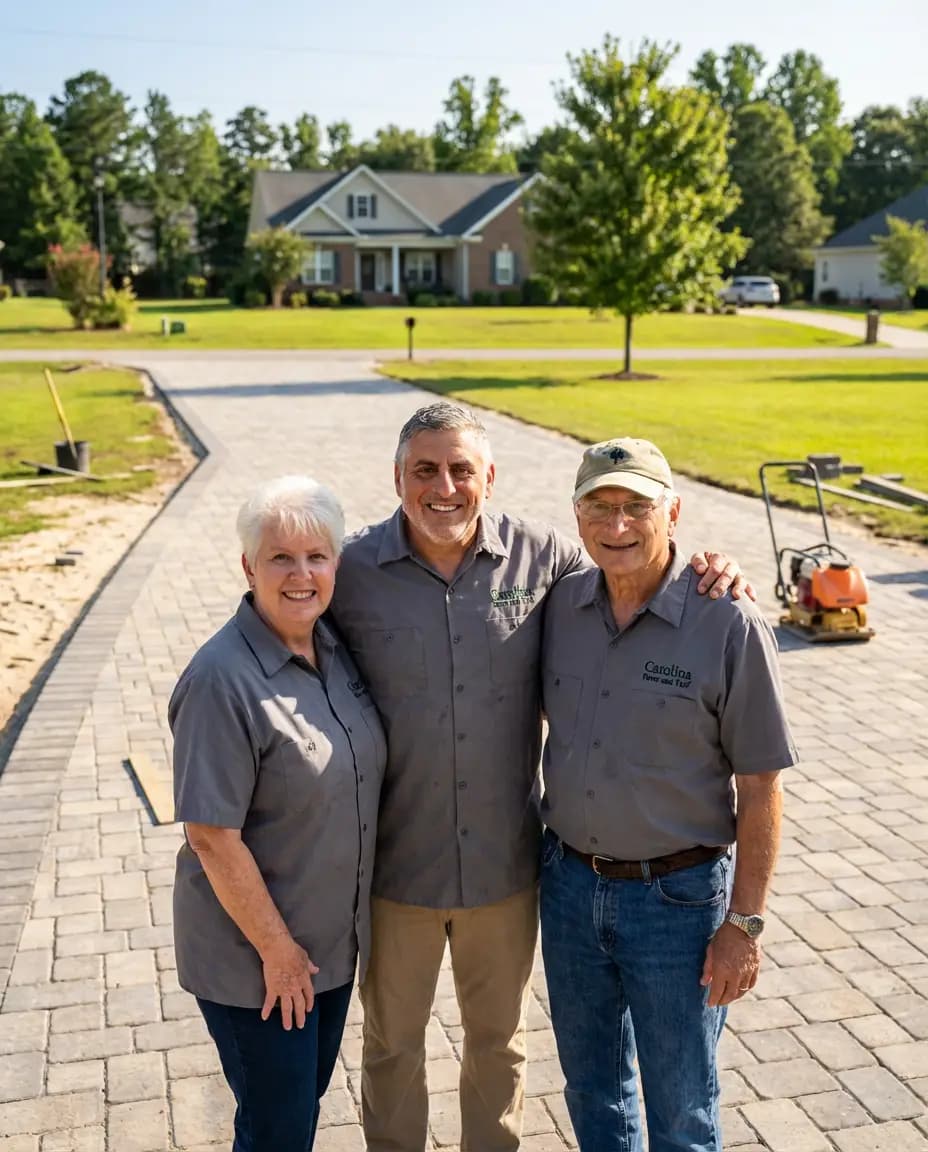
Owner, Carolina Paver & Turf
Michael Barbieri brings 10+ years of hardscape sales and construction experience, helping Lowcountry homeowners design patios, driveways, turf, and marine spaces built for coastal conditions.
Related Reading
Keep researching — these guides go deeper on what you read here.
Not sure which is right for your lot?
We assess your soil, grade, and drainage and recommend the system that actually fits — not the one that is easiest to sell. Free on-site assessment, no obligation.