
Understanding Drainage in the Lowcountry
In the Lowcountry, drainage is the single biggest factor in how long a patio, driveway, or walkway lasts. Sandy soil, a high water table, 49-plus inches of yearly rain, and flat, low-lying flood-prone lots mean water has nowhere easy to go — so where you send it determines everything.
We have rebuilt enough failed hardscapes to say it plainly: in this region, water is what kills a project. Not the pavers, not the stone — the water that sits under them, behind them, or against the house. Get drainage right and a well-built surface lasts for decades. Get it wrong and even a perfect base washes out from underneath. Here is how drainage actually works on a Lowcountry lot.
The Principles
Slope water away from structures. Every hardscape surface should pitch water away from the house. The widely used target is about 2% — roughly 1/4 inch of fall per foot — which sheds water reliably without feeling tilted. The practical floor is about 1% (1/8 inch per foot); below that, water pools. Permeable surfaces can run much flatter because the water drains down through them instead of across.
Know where the water goes before you build. Surface water should be directed to a planted area, a drain, or a stormwater feature that can accept it — never toward the foundation, a neighbor’s lot, or a low spot that already floods. And the base itself has to be able to shed or store the water that reaches it; a base that traps water in our climate stays saturated and soft.
The Solutions (and When to Use Them)
- Surface grading / regrading — the first and cheapest defense. Re-shaping the ground so water flows by gravity to where you want it. Often the whole fix; always the foundation for the others.
- Permeable paver systems — instead of shedding water, they infiltrate it through open joints into a stone reservoir, reducing runoff and recharging the ground. Ideal where you want to manage stormwater on site. (See our permeable vs. dry-set comparison.)
- French drains — a gravel-filled trench with a perforated pipe that intercepts subsurface and surface water and carries it to an outlet. Best for soggy areas and relieving water pressure near foundations, where there is no persistent standing water to collect.
- Channel / trench drains — a linear grated drain that captures sheet flow off large paved areas like driveways and pool decks and pipes it away.
- Catch basins — a boxed inlet at a low point that collects standing surface water and routes it into a pipe. The right tool when water already pools.
- Dry wells — an underground stone-filled chamber that receives collected water and lets it infiltrate slowly. Great in sandy, well-draining soil; weak in tight clay.
- Downspout management — roofs concentrate huge volumes at a few points. Extend downspouts well away from the foundation (commonly 4 to 10 feet) or tie them underground to a pipe or dry well. One of the highest-impact, lowest-cost fixes — and a frequent cause of settling when ignored.
A simple way to choose: if there is no standing water, a French drain (subsurface interception) often suffices; if there is standing surface water, you need a catch basin or yard drain to capture it. Sandy, loamy soil favors dry wells for infiltration; heavy clay favors collect-and-convey to a piped outlet.
What Makes the Lowcountry Different
A high water table means infiltration-based solutions have less room to work — a dry well or permeable reservoir can fill from below during wet, high-tide periods, so designs may need underdrains, raised grades, or extra storage rather than assuming the soil will swallow everything. Tidal and flood considerations matter too: on low-lying lots, the place you are draining to may also be full during a storm or king tide, so a system that relies on a low outlet can back up. Good design accounts for that — it keeps working, or fails gracefully, under high water.
Soil dictates strategy. The Lowcountry has both fast-draining marine sand (great infiltration, poor structural support) and poorly drained soils with clay layers and high runoff — sometimes within one yard. You infiltrate in sand and collect-and-convey in clay, which is why the soil should be assessed, not assumed. Many local jurisdictions also regulate stormwater runoff and impervious coverage, especially near waterways; permeable pavers can help meet those goals. (That is general awareness, not legal advice — always confirm local requirements.)
Finally, drainage protects your other structures. Keep concentrated water away from foundations and slabs, and behind a seawall or retaining wall uncontrolled drainage builds hydrostatic pressure and washes out the backfill — proper weeps and managed grading are what protect the wall. The same water that sinks pavers undermines walls, so we plan it as one system across the whole site.
Signs Your Lot Has a Drainage Problem
Drainage trouble usually announces itself long before a hardscape fails. Watch for these warning signs, especially in the days after a heavy rain:
- Standing water that lingers more than a day after the rain stops, or soggy, spongy spots that never fully dry out.
- Mulch, pine straw, or soil washing across walkways and into low spots — a sign water is moving fast across the surface with nowhere to go.
- Pavers or stepping stones that have started to settle, especially near downspouts and edges, where concentrated water undermines the base.
- A white, chalky film (efflorescence) on pavers or walls, or green algae in shaded areas — both point to water sitting where it should not.
- Water pooling against the foundation or a damp crawlspace, which is a structural concern, not just a nuisance.
- Erosion or mushy soil behind a seawall or retaining wall, a sign water is building pressure behind the structure instead of draining.
Catching these early is far cheaper than rebuilding a failed patio or wall. When we walk a site, the first thing we map is where water comes from, where it sits, and where it can safely go — because every other decision depends on that answer.
Frequently Asked Questions
What slope should a patio or driveway have for drainage?
About 2% — roughly 1/4 inch of fall per foot — pitched away from the house. The practical minimum is about 1% (1/8 inch per foot); below that, water pools. Permeable systems can be much flatter because water drains down through them rather than across.
Do pavers help with drainage?
Standard pavers shed water, so the grade does the work. Permeable pavers actively help — they let water infiltrate through the joints into a stone reservoir below, reducing runoff and standing water.
What is a French drain?
A gravel-filled trench with a perforated pipe that collects subsurface and surface water and carries it by gravity to an outlet. Typical trenches are 6–12 inches wide and 18–24 inches deep on a gentle slope. They are used to dry out soggy areas and relieve water pressure near foundations.
How do I fix standing water in my yard?
First find the low point and somewhere lower to send the water. Standing surface water usually calls for a catch basin or yard drain to capture it, often piped to a dry well, daylight outlet, or storm system; sometimes regrading alone solves it. In clay, plan to collect and convey; in sand, infiltration may work.
French drain or dry well — which do I need?
A French drain moves intercepted water to an outlet; a dry well stores and infiltrates collected water into the soil. They are often used together: collect with a basin or French drain, then discharge into a dry well where the soil drains well.
Are permeable pavers good for flooding?
They help significantly with on-lot stormwater by storing and infiltrating water in a stone reservoir, and can cut surface runoff dramatically. But in a high-water-table or active-flood situation the reservoir can fill from below, so they are part of a flood strategy, not a standalone cure for a lot that floods from rising water.
Will permeable pavers clog over time?
The joints can collect fines and need periodic maintenance — cleaning and replenishing the joint stone — to keep infiltration rates up. With upkeep they keep working; neglected, surface infiltration drops.
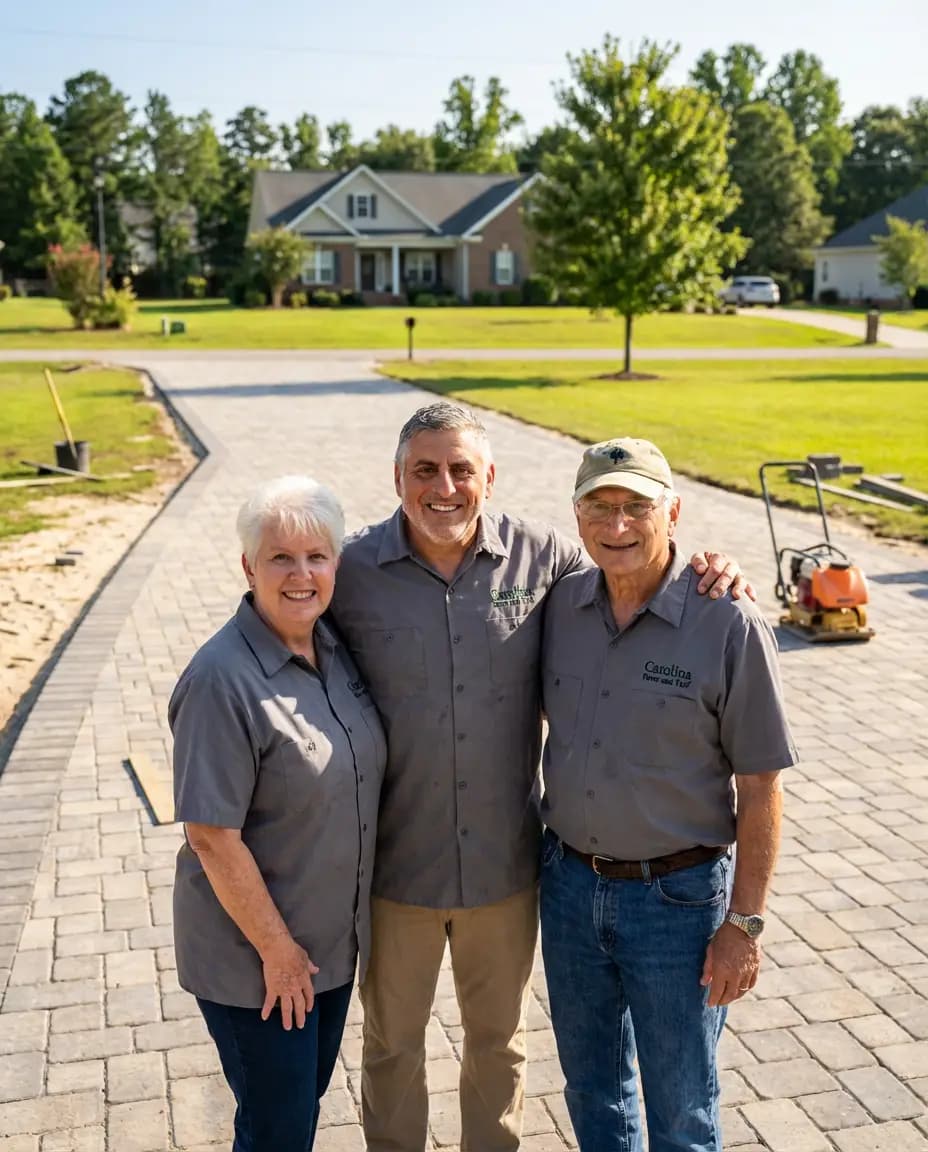
Owner, Carolina Paver & Turf
Michael Barbieri brings 10+ years of hardscape sales and construction experience, helping Lowcountry homeowners design patios, driveways, turf, and marine spaces built for coastal conditions.
Related Reading
Keep researching — these guides go deeper on what you read here.
Water showing up where it shouldn’t?
We diagnose how water moves across your whole lot and design drainage that protects your hardscape, foundation, and waterfront. Free on-site assessment, no obligation.