
Permeable Interlocking Concrete Pavement (PICP): A Lowcountry Technical Guide
PICP carries traffic like a conventional paver surface while managing stormwater inside the pavement. The key is a complete system: aggregate-filled joints, open-graded bedding, a stone reservoir, tested subgrade, and a maintenance plan.
Charleston’s problem is not a shortage of rain. It is a shortage of places for rain to go. Flat grades, high water tables, tidal outfalls, and impervious-cover limits mean every new driveway, parking court, and pool deck has to answer one question: where does the water go?
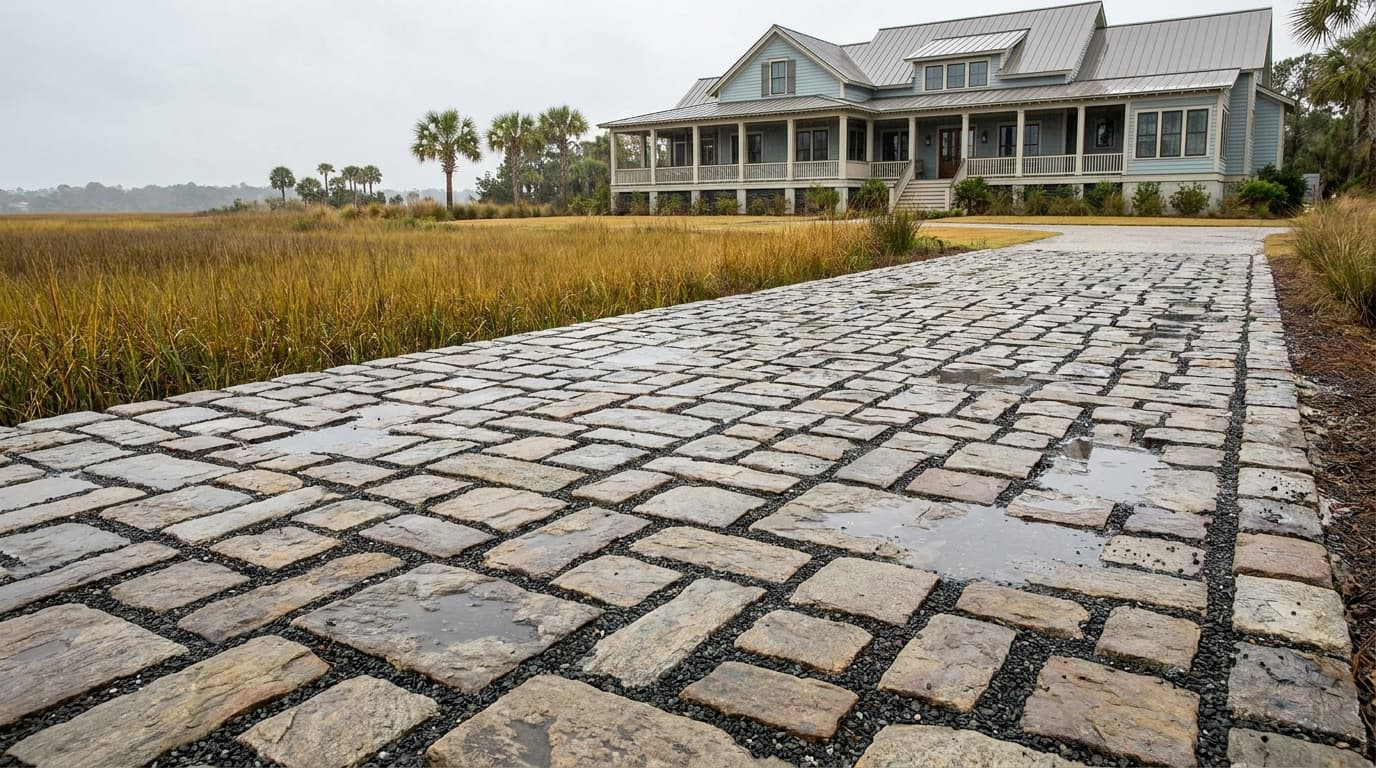
Permeable interlocking concrete pavement answers that question inside the pavement itself. Solid concrete pavers are separated by permanent, aggregate-filled joints and openings, then built over clean, open-graded stone that stores water and lets it infiltrate the soil below. The system reduces runoff volume and peak flow while filtering pollutants. It is a pavement and a stormwater best management practice in one assembly.
1. How a PICP System Is Actually Built
From the top down, a correctly specified PICP assembly is a filter and a reservoir as much as it is a driving surface.
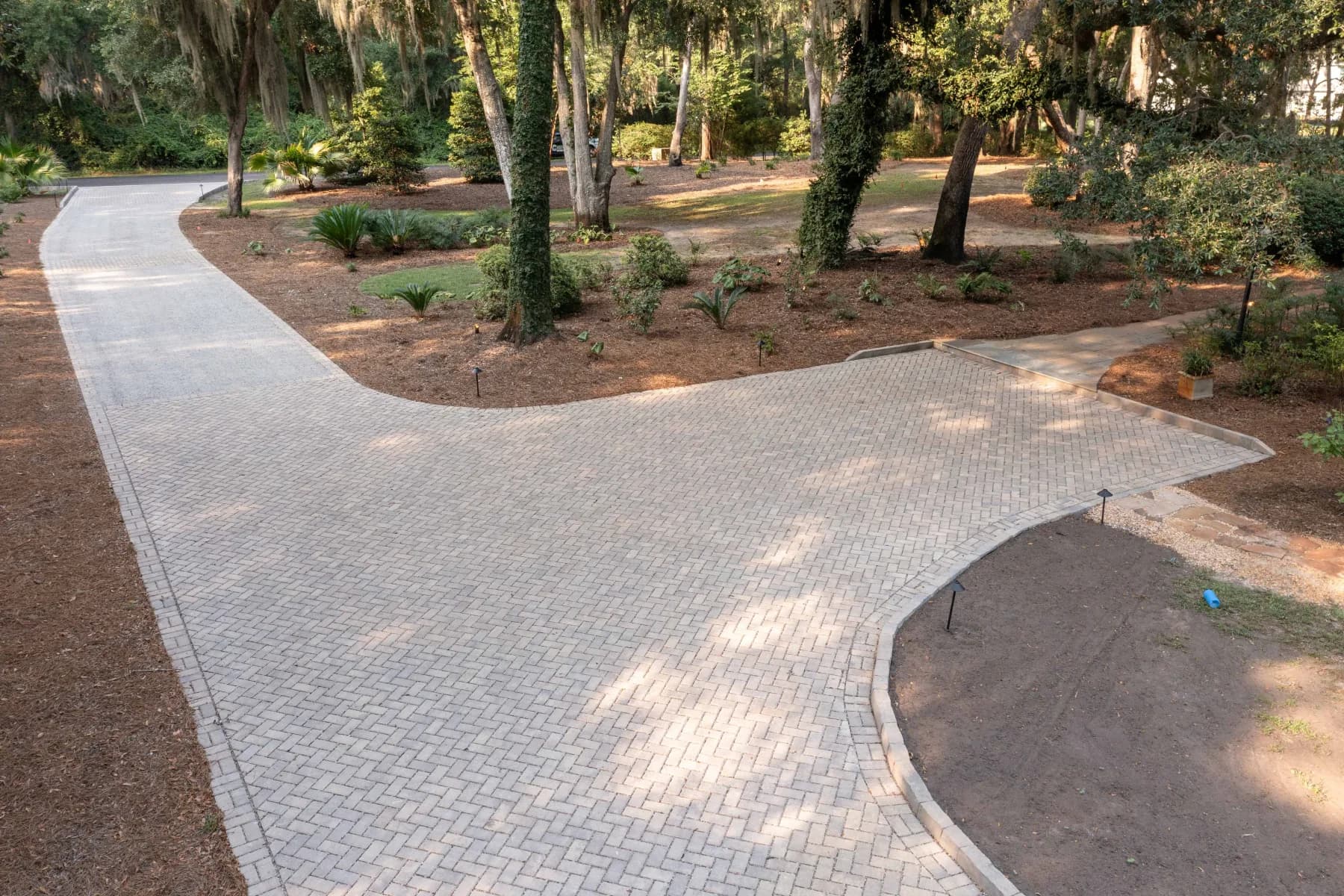
- Paving units. Concrete pavers conform to ASTM C936. Vehicular PICP uses units at least 3⅛ inches (80 mm) thick, typically laid in herringbone or an interlocking random pattern. Joints and openings commonly make up about 5% to 15% of the surface.
- Jointing stone. Joints receive washed, open-graded ASTM No. 8, No. 89, or No. 9 stone—not sand. Wider joints with No. 8 stone tend to retain their infiltration capacity longer; No. 10 stone clogs more quickly and is not recommended.
- Open-graded bedding. Typically 1½ to 2 inches of washed ASTM No. 8 stone. Sand is not used as PICP bedding.
- Open-graded base. Usually 4 inches of washed ASTM No. 57 stone, forming a transition between the bedding and larger reservoir stone.
- Open-graded subbase reservoir. Washed ASTM No. 2, No. 3, or No. 4 stone provides the main storage volume. Base and subbase aggregate should have at least 32% porosity; vehicular aggregate should be crushed with at least 90% fractured faces.
- Geotextile, edges, and underdrains. Geotextile separates vertical soil walls where no curb is present and may be used over the subgrade. Edge restraints hold the paver field in place. Underdrains are added where native soil cannot accept the design volume.
CMHA choke criteria keep adjacent stone layers from migrating:
D50 base ÷ D50 bedding ≤ 25; D15 base ÷ D85 bedding ≤ 5.
D50 subbase ÷ D50 base ≤ 25; D15 subbase ÷ D85 base ≤ 5.
In practice, No. 8 bedding chokes into No. 57 base, which chokes into No. 2, 3, or 4 subbase. Every layer remains open enough to store and move water without letting the finer aggregate disappear into the coarser layer.
2. Why 15% Open Area Does Not Mean 15% Pervious
A PICP surface with 15% open area is not 85% impervious. Rain that lands on a solid paver runs only a fraction of an inch into an adjacent joint. Functionally, the whole surface accepts rainfall.
Field research cited by CMHA has measured surface infiltration in the hundreds—and sometimes more than one thousand—inches per hour. North Carolina monitoring also recorded 97% to 99% infiltration across 40 storms on surfaces with 8.5% and 12.9% open area. Joint stone gradation, joint width, surface slope, and sediment loading matter more than open-area percentage by itself.

3. Siting, Infiltration, and Reservoir Sizing
PICP belongs downslope of waterproofed foundations, with positive surface drainage. Most systems are built at slopes of 2% or less and typically no more than 5%. Steeper sites can be terraced, but a subgrade slope of 3% or more calls for engineered check dams inside the reservoir so water does not simply run to the low end.
There are three basic hydraulic configurations:
- Full infiltration: all stored water enters the subgrade; no underdrain.
- Partial infiltration: water infiltrates the soil and excess exits through underdrains.
- No infiltration: an impermeable liner and underdrains provide detention and treatment where infiltration is prohibited or risky.
Slow soil does not automatically rule PICP out. Even soil infiltrating at only 0.01 inch per hour can accept about 0.5 inch in 48 hours. The important part is testing the compacted, saturated subgrade; dry, loose soil gives an unrealistically optimistic result. Reservoir drawdown is commonly designed in the 24-to-72-hour range, subject to local requirements.
Reservoir thickness is calculated twice: once for stormwater storage and once for traffic. The thicker result governs. Structural tables account for lifetime equivalent single axle loads (ESALs), soaked subgrade CBR, and how many days each year water remains in the reservoir.
- Pedestrian: at least 6 inches of No. 57 base; a separate subbase may not be needed.
- Residential driveway: at least 6 inches of No. 2/3/4 subbase below 4 inches of No. 57 base, or a 10-inch single No. 57 section on suitable small projects.
- Vehicular: 80 mm pavers, roughly 2 inches of No. 8 bedding, 4 inches of No. 57 base, and a subbase sized from the design tables.
High traffic—roughly above one million lifetime ESALs—or stabilized base sections warrant an experienced pavement engineer. For conventional alternatives, see our permeable vs. dry-set paver comparison.
4. Where PICP Construction Succeeds or Fails
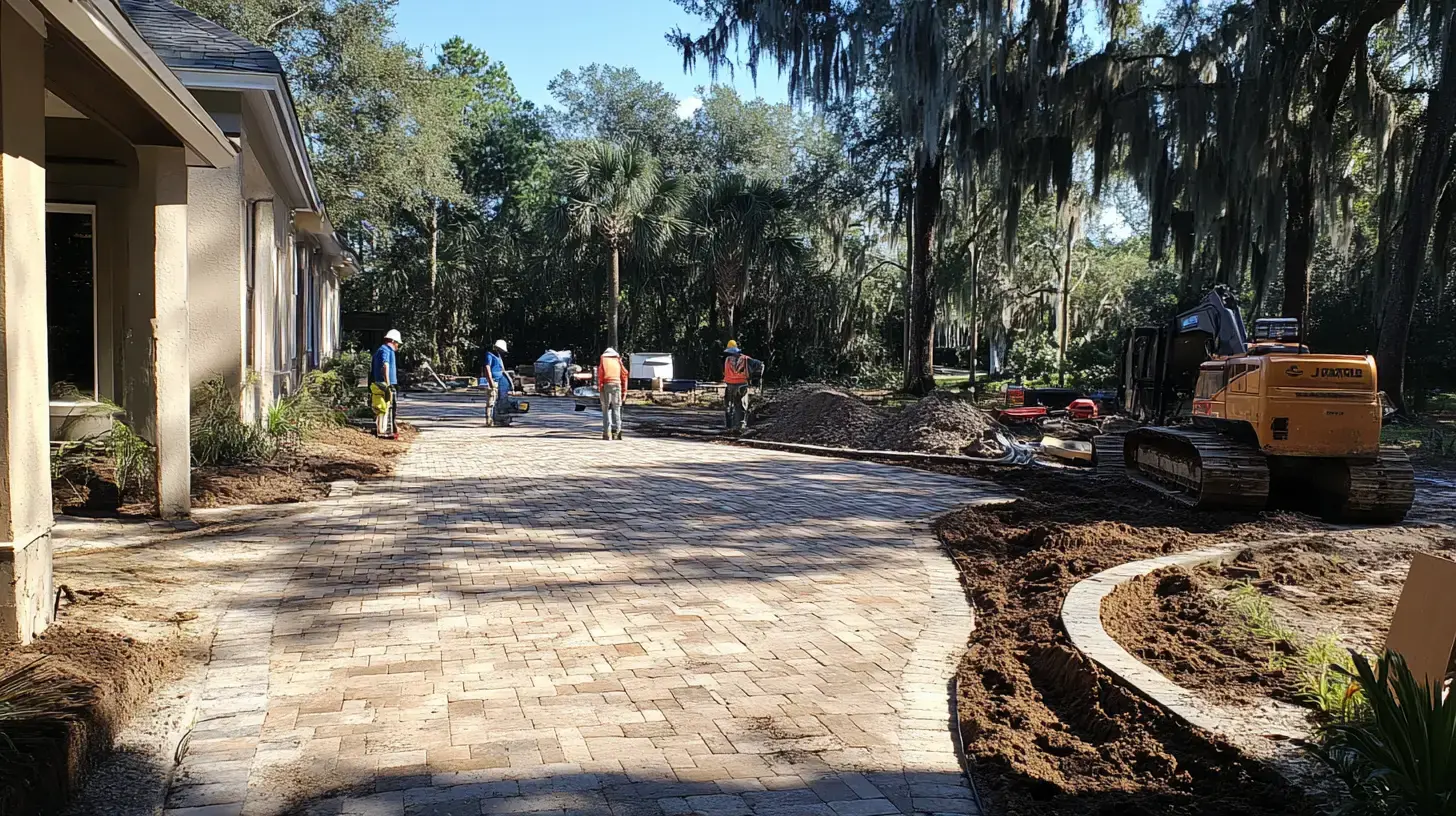
- Protect the subgrade. Keep construction traffic and sediment off it; place about 12 inches of aggregate cover before trafficking the section.
- Compact in controlled lifts. The subbase surface should be within ±2 inches over a 10-foot straightedge; the compacted No. 57 base should be within ±½ inch.
- Verify stiffness, not density. Open-graded stone cannot be meaningfully checked with conventional nuclear-density testing. A lightweight deflectometer provides a defensible stiffness record.
- Control the bedding. Screed it to about ±¼ inch over 10 feet.
- Allow for settlement. After compaction, pavers should sit no more than ⅜ inch above curbs or edge restraints.
- Build a mock-up. Confirm grades, paver tolerances, inspection intervals, and workmanship before production work begins.
- Return after installation. At about six months, inspect the surface, top off joint stone, and confirm infiltration.
These steps complement the broader base and compaction principles in our guide to paver base depth.
5. Maintenance Is a Design Assumption
Neglected PICP normally loses infiltration before it loses structural capacity. Research summarized by CMHA found unmaintained surfaces can lose 75% to 90% of their initial infiltration during the first several years. Since initial rates are exceptionally high, the pavement may still accept ordinary storms—but that margin should be measured, not assumed.
- Keep soil, mulch, and construction sediment from running onto the pavement.
- Sweep or vacuum before fines work deeply into the joints.
- Test surface infiltration using ASTM C1781 and retain the results as a year-over-year baseline.
- Inspect at least annually and after nearby landscape or soil work.
- Restore clogged joints with regenerative-air or true-vacuum equipment, then refill them with clean No. 8, 89, or 9 stone.
Unlike monolithic porous pavement, individual concrete pavers can also be lifted and reinstated for utility access. That repairability is one reason PICP is attractive for long-lived residential and commercial sites.
6. Why Owners and Design Professionals Choose PICP
- It manages stormwater inside the pavement footprint and may reduce other detention, inlet, or piping needs.
- It can help a project respond to impervious-cover restrictions and stormwater-credit programs.
- High-strength concrete units provide a finished driveway, patio, pool deck, or parking-court appearance.
- The surface is repairable and reinstatable without permanent patch scars.
- Fast drainage reduces standing water and complements a whole-site Lowcountry drainage plan.
7. How Carolina Paver & Turf Approaches PICP
We serve Charleston, Mount Pleasant, Daniel Island, Isle of Palms, Sullivan’s Island, Johns Island, Seabrook, North Charleston, Summerville, Beaufort, Bluffton, and Hilton Head Island. Our permeable-pavement process follows the same sequence as the CMHA manual:
- Review grades, water table, foundation setbacks, and infiltration on compacted, saturated soil.
- Select a full-, partial-, or no-infiltration system with the project engineer and local stormwater requirements in view.
- Size the reservoir for both storage and traffic; the thicker design controls.
- Use only washed, open-graded, choke-compatible ASTM aggregate—no sand in the PICP section.
- Protect the subgrade, compact and test lifts, verify tolerances, and establish workmanship with a test panel.
- Provide a maintenance plan, baseline infiltration reading, and six-month follow-up.
- Close the project with our Completion of Scope sign-off and 10-year workmanship guarantee.
PICP works best when it is coordinated with the rest of the property. Our Lowcountry drainage guide explains how high water tables, outlets, and surrounding grades affect that larger system.
Frequently Asked Questions
What is permeable interlocking concrete pavement?
PICP is a structural pavement made from solid concrete pavers with aggregate-filled joints over open-graded stone. Water passes through the joints into the stone reservoir, where it infiltrates the soil, exits through an underdrain, or both.
Is sand used under permeable pavers?
No. A PICP assembly uses washed, open-graded aggregate in its joints, bedding, base, and subbase. Sand closes the voids the system needs for storage and drainage.
Can permeable pavers work in slow-draining Lowcountry soil?
Yes, but the system may need a partial-infiltration or no-infiltration design with underdrains. The design should be based on testing performed on compacted, saturated subgrade rather than dry, loose soil.
Do permeable pavers need maintenance?
Yes. Keep sediment and mulch off the surface, inspect at least annually, and vacuum or restore clogged joints when testing shows reduced infiltration. Maintenance is part of the engineering assumption behind the pavement design.
Michael Barbieri
Owner, Carolina Paver & Turf
Michael Barbieri brings 10+ years of hardscape sales and construction experience, helping Lowcountry homeowners design patios, driveways, turf, and marine spaces built for coastal conditions.
Related Reading
Keep researching — these guides go deeper on what you read here.
Planning a permeable pavement project?
We can review the grades, soil, traffic, and stormwater requirements and help turn them into a buildable PICP section.