The honest answer
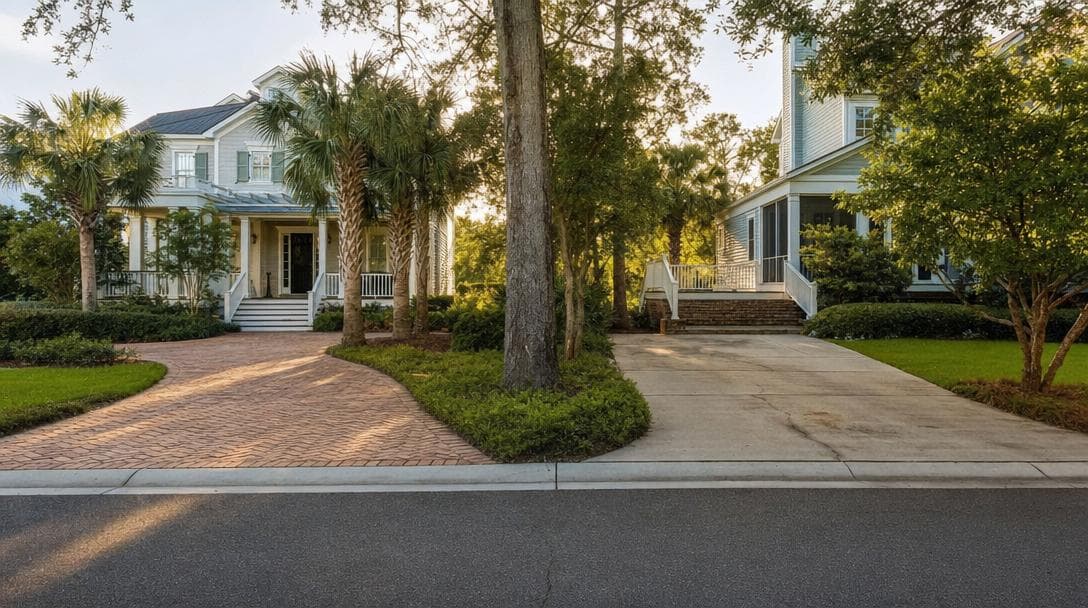
For driveways specifically, pavers are the better long-term investment in coastal South Carolina almost without exception. Concrete is roughly 50% cheaper upfront but lasts half as long, cracks decisively within 10–15 years under typical Lowcountry conditions, and cannot be repaired without visible patches. The case for concrete on driveways is narrower than for patios — usually only short ownership windows or tight budgets justify it.
Paver Driveway vs Concrete Driveway: Side by Side
| Dimension | Pavers | Concrete | Winner |
|---|---|---|---|
| Installed cost (600 sq ft drive) | $30,000 – $60,000 | $3,600 – $9,000 | Concrete |
| Realistic lifespan | 30 – 50+ years | 10 – 20 years | Pavers |
| Crack resistance under vehicle load | Excellent — load redistributes across stones | Poor — wheel paths crack first | Pavers |
| Oil & fluid staining | Affected stones can be replaced | Permanent staining; sealer slows but does not prevent | Pavers |
| Tree root tolerance | Flexible system absorbs minor lift | Roots crack and lift slabs | Pavers |
| Curb appeal & resale | Significant upgrade — photographs as premium | Baseline expectation; no resale uplift | Pavers |
| Settling repair | Lift, re-level base, reset stones | Cut, jack, mudpump or replace section | Pavers |
| Installation time | 7 – 14 days, drivable immediately after | 3 – 5 days, no vehicles for 7+ days | Concrete |
| Color & design options | Borders, banding, color patterns, herringbone | Gray; broom finish or salt finish at extra cost | Pavers |
Why Driveways Punish Concrete Faster Than Patios
Patios get foot traffic, furniture, the occasional grill drop. Driveways get 4,000-pound vehicles repeatedly hitting the same wheel paths, point-load concentrations from jack stands and trailer dollies, oil and brake-fluid drips, and root pressure from any tree within 30 feet of the surface. A driveway is the most punished concrete on most properties.
In Lowcountry conditions, concrete driveways typically show their first stress cracks in the wheel paths within 5–8 years. By year 12–15, structural cracks have propagated through the slab and any repairs are visible. By year 20 the driveway is functionally usable but visually past its useful life. Pavers do not follow that curve — they accumulate minor settling in the same window but do not crack in any equivalent way.
The Repair Math on Driveways Is Brutal for Concrete
A common scenario: a tree root lifts a 4x4 section of concrete driveway in year 10. The options are (a) leave it and accept the trip hazard, (b) mud-jack it and accept a visible seam, (c) cut and replace the section and accept a permanently mismatched color, or (d) tear out and repour the entire driveway. Most homeowners end up in option (b) or (c).
With pavers, the same scenario is a half-day fix. We lift the affected pavers, address the root, re-level the base, drop the same pavers back in. The driveway looks identical to before. We have done this on driveways approaching 25 years old where the original pavers are still in production and we are reusing stones from the original install.
Resale: The Driveway Is Your Largest Curb Appeal Surface
For most coastal SC homes, the driveway is the largest single hardscape surface visible from the street. Real estate agents tell us repeatedly that paver driveways generate more "what is the price?" inquiries from drive-by traffic than nearly any other exterior feature. Concrete driveways do not — they are a baseline expectation, not a feature.
On listings $500K and up, the curb appeal gap between a paver driveway and a 12-year-old cracked concrete driveway is dramatic. We have had clients pull comparable listings to estimate the impact; the consistent finding is that paver driveways add measurably to perceived value and reduce time on market.
Maintenance Reality: What Each Driveway Actually Needs
There is a persistent myth that paver driveways are high maintenance. The actual maintenance schedule is lower than for concrete. Polymeric joint sand may need topping off every 5–7 years (a single afternoon, $200–$400 of material). An optional re-seal every 7–10 years deepens color and improves stain resistance. That is the full list.
Concrete driveway maintenance, by contrast, is continuous after year 5. Resealing every 2–3 years is standard. Crack filling becomes a recurring item starting around year 7–10. Stain removal from oil drips requires acid-etch chemistry that itself shortens the slab life. Each maintenance cycle is small, but they accumulate, and skipping them shortens the slab life dramatically.
Over a 25-year ownership window, the total maintenance hours and dollars on a concrete driveway often exceed those on a paver driveway by a factor of two or three. People assume concrete is simpler because it looks like one solid surface; the reality is that being one solid surface means every problem is a problem with the entire driveway.
When Pavers Wins
You will own the home for 5+ years
Lifespan economics dominate. A concrete driveway will visibly fail within typical ownership; a paver driveway will not.
You have mature trees within 30 feet of the driveway
Live oak, palmetto, magnolia, and pine root systems all lift slabs. Pavers absorb the same movement without cracking.
Curb appeal matters to you
For any home above the local median value, the driveway is the single largest curb appeal surface. Pavers turn it into a feature.
When Concrete Wins
We do not install concrete, but we will not pretend pavers are always the right call. Here is when they are not.
Selling within 12–24 months and need the cheapest viable option
A fresh concrete pour will photograph well for listing and avoid the cost of a paver install you will not be around to benefit from. Honest answer.
Strict budget and a hidden side driveway
A secondary side-yard or alley driveway that is not visible from the street and rarely used can justify concrete on cost alone.
You need vehicle access in under a week
Both materials require base preparation, but a poured concrete driveway can sometimes hit a tighter calendar. Pavers are drivable immediately after the final compaction; concrete requires a 7+ day cure before vehicle use.
Explore Our Paver Services
Related Reading
Other Material Comparisons
Frequently Asked Questions
How long does a paver driveway last vs a concrete driveway?
In the Lowcountry, properly installed paver driveways routinely last 30–50 years. Poured concrete driveways typically show structural failure within 10–20 years. The difference comes from the flexible joint system in pavers absorbing the substrate movement that cracks rigid slabs.
Are paver driveways high maintenance?
Lower than most people assume. Joint sand may need topping off every 5–7 years. Optional sealing every 5–10 years extends color and stain resistance. There is no equivalent to crack repair, slab patching, or annual resealing of a concrete driveway.
Can a paver driveway handle heavy vehicles (trucks, RVs, boats)?
Yes — with the right base. We build heavy-vehicle paver driveways with deeper base preparation (10+ inches of compacted aggregate), thicker pavers rated for vehicular use, and edge restraints sized for the load. The system is engineered for the actual use case.
Will weeds grow between paver driveway joints?
Modern polymeric joint sand effectively blocks weed germination for 5–10 years between applications. The "weeds in pavers" problem people remember was a 1990s-era issue with regular masonry sand, which is no longer how we install.
How much does a paver driveway cost in Charleston SC?
For a typical 600 sq ft single-vehicle driveway in the Charleston, Bluffton, or Beaufort area, expect $13,200–$24,000 installed from uninsured, unlicensed installers and $30,000–$60,000 installed from a licensed, bonded and insured contractor with a workmanship guarantee. The range covers paver selection, base depth requirements, subgrade composition, and whether the existing driveway needs tearout and disposal. Detailed estimates are free.
Can I install pavers over an existing concrete driveway?
In some cases yes — if the existing slab is sound, drains correctly, and you have height clearance at the garage threshold and street curb. We assess this case by case. When the existing slab is already cracked or pumping water, we recommend tear-out and full base install — building on a failing slab guarantees you inherit the failure.
Owner, Carolina Paver & Turf
Michael Barbieri brings 10+ years of hardscape sales and construction experience, helping Lowcountry homeowners design patios, driveways, turf, and marine spaces built for coastal conditions.
Still deciding? Get a real quote.
Free on-site assessment, no obligation. We will tell you honestly whether pavers are the right call for your project, your timeline, and your budget.