The honest answer
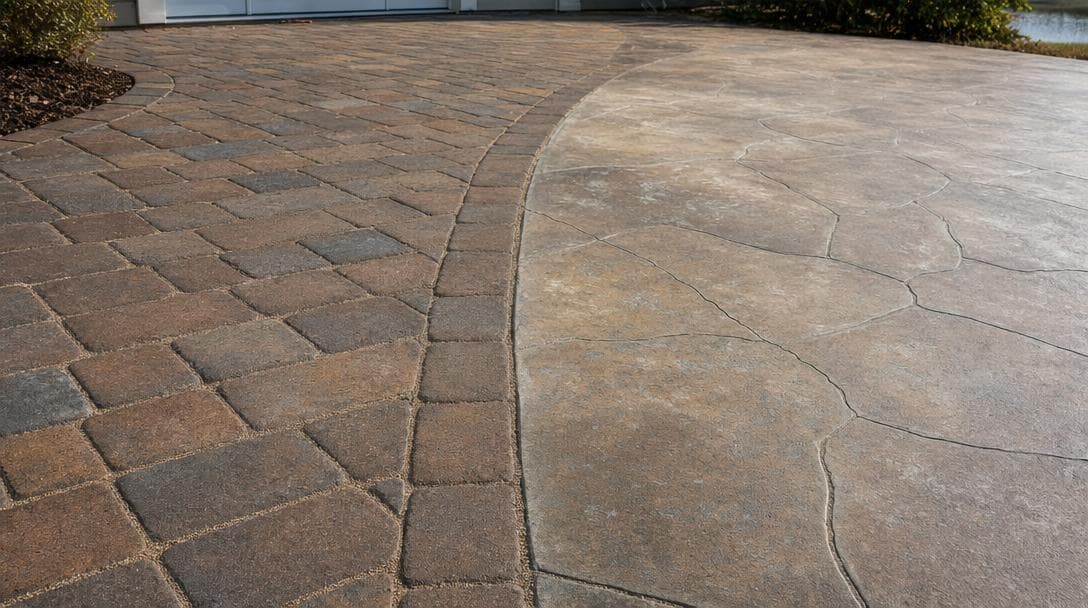
Stamped concrete looks like pavers at year one. By year five, it usually does not. Stamped concrete cracks like all concrete cracks, the color fades, and the texture wears smooth in traffic areas — and there is no clean way to repair any of it. Real pavers cost 30–60% more upfront and outlast stamped concrete by 20+ years. That said, stamped concrete is faster to install and lower-budget, and on a short ownership window it can still pencil out.
Pavers vs Stamped Concrete: Side by Side
| Dimension | Pavers | Stamped Concrete | Winner |
|---|---|---|---|
| Installed cost (per sq ft) | $35 – $65 | $10 – $20 | Stamped Concrete |
| Realistic lifespan | 30 – 50+ years | 8 – 25 years before noticeable failure | Pavers |
| Year-one appearance | Excellent, true texture and color depth | Excellent — that is the entire pitch | Tie |
| Year-five appearance | Same as year one with minor patina | Faded color, smoothing in traffic areas, possible cracks | Pavers |
| Crack risk | Flexes with substrate — no slab cracks | Rigid slab — cracks always come, and they break the stamp pattern | Pavers |
| Repair experience | Lift and swap individual stones | Cannot match texture or color — visible patch forever | Pavers |
| Resealing requirement | Optional — extends life but not required | Required every 2–3 yrs to slow fading and surface wear | Pavers |
| Slip resistance (wet) | Good — natural texture per paver | Variable — sealer can become slick | Pavers |
| Design changes after install | Add, remove, expand any time | Cannot extend without mismatched seam | Pavers |
Year One: They Look Similar. That Is The Trap.
A new stamped concrete patio with crisp release powder and fresh sealer can look genuinely close to real pavers from across the yard. That is the whole reason the product exists, and it is fair to acknowledge: at install, stamped concrete is convincing.
The problem is that nothing about that comparison holds at year five. We get called to inspect stamped concrete patios all the time. The most common state we find: a network of stress cracks running diagonally through the stamp pattern, dramatic color fading in any area that gets afternoon sun, and a polished smoothness in the high-traffic walking paths where the texture has worn off.
The reason is simple. Stamped concrete is still concrete. It is one rigid slab pretending to be many small stones. The slab cracks for the same reasons every concrete slab cracks. The stamp pattern just makes the cracks more visible, because they cut across the fake "joints" instead of following them.
The Repair Problem No One Mentions Upfront
When real pavers are damaged, we pull up the affected stones and drop in new ones. The repair is invisible. When stamped concrete is damaged — by cracking, by a section sinking, by a contractor scraping it with a snow blade or trailer — there is no equivalent fix.
You cannot match the original color batch (it is sealer over concrete pigment that has weathered for years). You cannot match the stamp texture (the original stamps may have been from a discontinued line, and the new stamp will not press into already-cured concrete). You cannot match the sealer sheen. The result is always a visible patch, and the patch usually looks worse the longer it ages because it weathers at a different rate than the surrounding slab.
Homeowners who shipped stamped concrete expecting a paver-like outcome are routinely surprised by this gap. We are not.
When Stamped Concrete Is Still the Right Call
We will not pretend stamped concrete is never the answer. It has a real, narrow set of use cases. If you are selling within 2–3 years and care about year-one curb appeal more than long-term durability, the cost gap matters more than the lifespan gap. If your budget genuinely cannot stretch to real pavers and the alternative is bare gray concrete or no patio at all, stamped is a meaningful aesthetic upgrade over a plain slab.
Stamped also wins when site access is genuinely limited — a backyard with no equipment access for paver pallets, where pumping concrete is the only realistic install method. Those cases exist; they are rarer than people think.
Coastal SC Conditions: Why Stamped Concrete Fails Faster Here
The Lowcountry punishes stamped concrete on two fronts at once. UV intensity at this latitude, combined with reflected light off light-colored homes and pool decks, fades sealed concrete pigment 30–50% faster than inland installations in cooler climates. Color that a manufacturer says lasts 5 years lasts more like 3 here, and re-staining a stamped surface never matches the original — the pigment sits on top, not in the slab.
The second front is moisture. High humidity, frequent afternoon storms, and salt air all accelerate sealer breakdown. Sealers on stamped concrete are working harder than they would in Atlanta or Charlotte, and they fail sooner. When the sealer fails, the surface becomes a humidity sponge — efflorescence (white salt bloom) and surface scaling follow within a couple of seasons.
We have inspected stamped patios in Mount Pleasant, James Island, and Bluffton that were installed by reputable contractors and were already showing 7-year-old failure modes at year 4. The substrate did not move; the concrete chemistry did not fail; the climate just chewed through the surface treatment.
When Pavers Wins
You will own the home for 5+ more years
Stamped concrete typically starts showing its age between years 3 and 7. Pavers do not. If you will see the surface aging, you want real pavers.
You care how it looks during outdoor entertaining
Real pavers photograph well at any age. Stamped concrete looks new for a while, then visibly old. The shift happens faster on patios used heavily for furniture and foot traffic.
You are matching or extending an existing paver surface
You cannot extend a stamped concrete patio without a visible seam. Real pavers extend cleanly.
When Stamped Concrete Wins
We do not install stamped concrete, but we will not pretend pavers are always the right call. Here is when they are not.
Short ownership timeline + tight budget
If you are selling within 24 months and need a year-one curb appeal upgrade for the lowest possible cost, stamped concrete will read as "premium patio" in listing photos.
Severely restricted site access
No way to get pallets of pavers, base stone, and a compactor to the work area? Pumping concrete may be the only practical install method. Rare but real.
Very small, flat, hidden areas
For a 6x6 ft hidden side-yard pad where you want a hint of pattern without the cost, stamped concrete can pencil out.
Explore Our Paver Services
Related Reading
Other Material Comparisons
Frequently Asked Questions
Does stamped concrete really crack within 5 years?
In the Lowcountry, hairline cracks are extremely common within 2–5 years and structural cracks within 5–10. The reasons are the same as for plain concrete: clay soil movement, high water tables, hurricane substrate shift, and rigid slab failure under any of those. The stamp pattern does not prevent any of this.
Can I just reseal stamped concrete to keep it looking new?
Resealing every 2–3 years slows color fading and protects the texture, but it does not stop cracking or repair the surfaces that wear smooth from foot traffic. Resealing is required maintenance, not optional. Skipping it dramatically shortens lifespan.
Why do contractors push stamped concrete if pavers are better?
Honest answer: stamped concrete is faster to install (1–2 days vs 5–10 for pavers), requires fewer skilled hands, and has a higher per-day revenue margin for the installer. None of that translates to better outcomes for the homeowner. We do not install stamped concrete and will be straight with you about why.
Will stamped concrete add resale value like pavers do?
New stamped concrete reads as a patio upgrade in listing photos and helps appraisal at the moment of sale. Aged stamped concrete (5+ years) often reads as a project the buyer will need to redo. Pavers age into established curb appeal; stamped concrete typically does not.
How much more does a real paver patio cost than stamped concrete?
For a 400 sq ft patio: stamped concrete runs $4,000–$8,000; real pavers professionally installed run $14,000–$26,000. Stamped concrete is cheaper today, but it cracks with the slab, needs resealing every few years, and cannot be repaired invisibly. The gap shrinks once you factor in lifespan and resealing, and narrows further at resale.
Owner, Carolina Paver & Turf
Michael Barbieri brings 10+ years of hardscape sales and construction experience, helping Lowcountry homeowners design patios, driveways, turf, and marine spaces built for coastal conditions.
Still deciding? Get a real quote.
Free on-site assessment, no obligation. We will tell you honestly whether pavers are the right call for your project, your timeline, and your budget.